Spanish Real Estate After COVID-19: Impact and Housing Market Forecast
Contents
How is the market behaving during the epidemic? How will property prices change after the end of quarantine? This article features expert opinions and our forecast.
By mid-April, more than 18,000 people had died from coronavirus in Spain, with the number of infected running into hundreds of thousands. The country’s economy, including the local housing market, is suffering losses. Spanish real estate is particularly vulnerable in this situation, as its future largely depends on foreign investment. At the same time, borders remain closed, and potential buyers have no opportunity to come to Spain to view properties.
In this article, we analyze the current situation, provide expert opinions and forecasts for Spanish real estate.
What’s happening right now?
How has coronavirus already affected the market?
What happens next: expert opinions
1. What’s happening right now?

Spain became one of the first countries to declare a global quarantine. Essentially, the activities of most institutions (including government ones) are frozen, and citizens are urged to stay home. If you’re stopped on the street and can’t prove a valid reason for leaving home, you face a €600 fine in Spain. Accordingly, transactions are impossible to complete — offices aren’t working, local law firms and banks cannot authorize and complete operations.
The Spanish government decided to support the real estate market during the crisis. First, the possibility of freezing mortgages during the epidemic appeared. However, this option is only available to Spaniards who have lost their jobs or can confirm a significant reduction in income. Spain’s largest developers (Aedas Homes, Metrovacesa, Via Celere and others) supported these measures. They declared readiness to allow clients to indefinitely postpone their next payment. Additionally, entrepreneurs who lost more than 75% of their income in March can receive financial compensation. The loss of profit must be documented.
Also, despite all this, home construction in Spain resumed on April 13. Work is conducted in coordination with police, and the working day is shortened until 3:00 PM. Besides this, Virtoproprety experts note the following trends by mid-April 2020:
Transition to remote work mode
As for transactions, during quarantine they are practically impossible. Translation agencies, banks, notaries and most other companies announced “closing their doors” to clients and switched to remote work mode. This significantly limited the possibilities for conducting operations and narrowed the list of available remote services.
Spanish developers began offering online property viewings. At the moment, this is the only available activity and opportunity to communicate with clients. As a bonus, developers offer to reserve the desired property for a small amount of €500. You can cancel the reservation within a month without penalty. This scheme was proposed by one of the developers in the new Alicante district — Playa San Juan Pau 5.
Construction companies are in no hurry to offer discounts
The Virtoproprety database features more than 1,600 new construction properties throughout Spain and more than 300 developers. It’s available and open to all portal visitors. These include both large companies and local developers. Since the introduction of quarantine in Spain, we daily monitor developer offers, price updates and special conditions. Only a few construction companies have offered significant discounts and bonuses. These can be either cash bonuses or options where furniture or a parking space is included in the housing cost.
Construction companies don’t plan to engage in dumping yet. There are several reasons for this:
— quite limited supply of new construction related to land shortage in the coastal zone;
— financial stability of developers — no need to “collect money” from clients to conduct construction work;
— high speed of residential complex construction — 12 to 16 months on average. Properties currently under construction will be completed by the end of 2020 — mid-2021. Since everyone expects market recovery during this period, there’s no reason for panic.
However, the situation may change when Europe finally emerges from quarantine and the economic consequences become obvious. We’re monitoring the situation and providing our clients with daily updates.
Secondary market — listings marked “urgent sale”
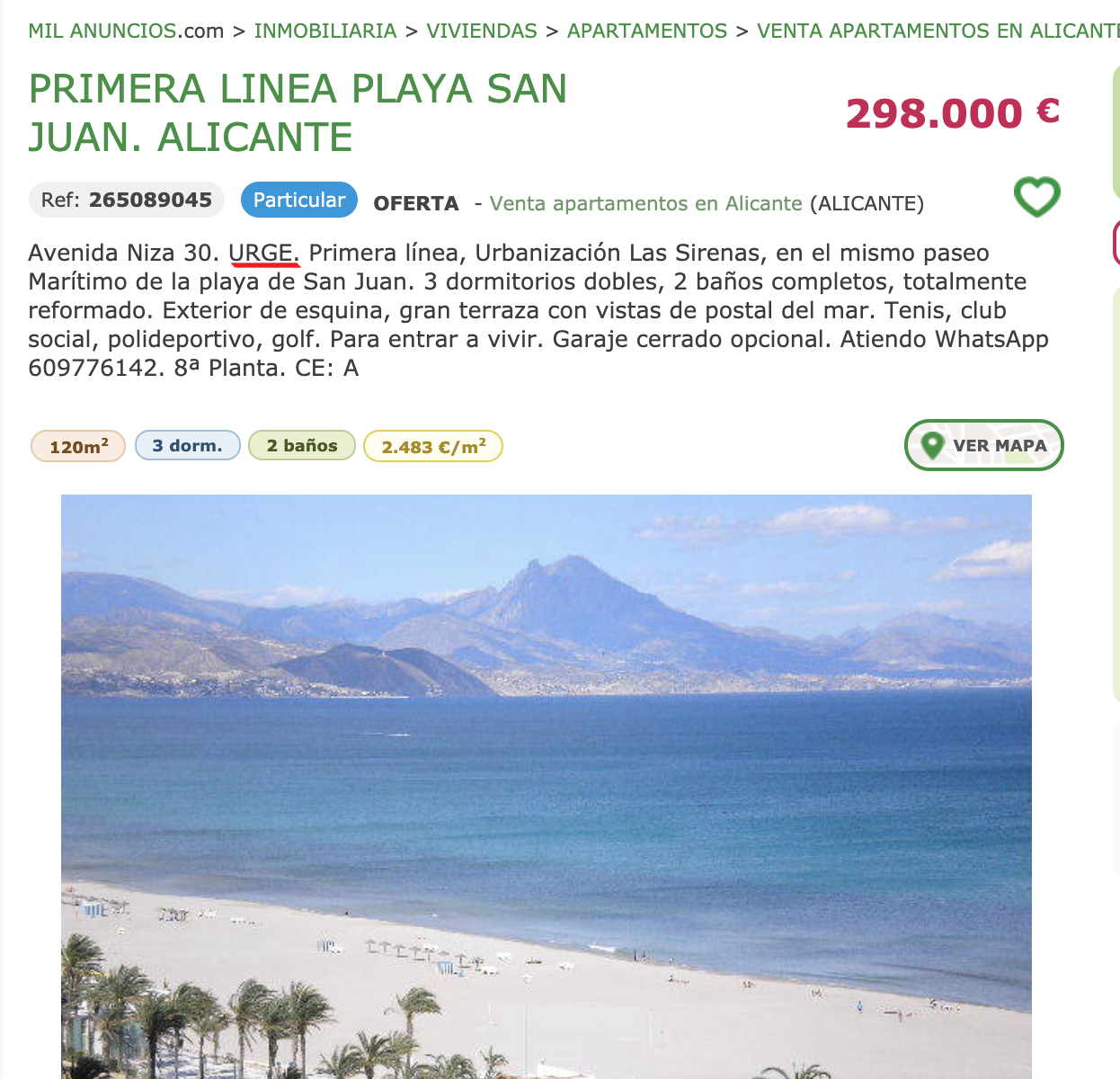
The situation on the secondary market is somewhat different. This is where attractive offers can be expected. Since late March, listings with “urgent sale” or “price reduction” labels from owners have appeared on well-known Spanish portals.
There aren’t many such listings yet, but they appear every day.
The secondary market is more sensitive to any changes. And it’s not about panic, because selling real estate at dumping prices isn’t the best idea. It’s about “forced” sales when owners can’t afford the expenses of a second or third apartment or house by the sea. This is the most painful situation for those who use passive rental income to finance mortgages and pay housing maintenance costs.
In any case, at the moment there are neither dramatic changes nor sharp price drops.
2. How has coronavirus affected the market?

No one knows when the epidemic will end, but it’s already obvious that even in a short period, COVID-19 has significantly affected the global economy, including the real estate sector. In particular, most banks in Spain have suspended mortgage lending and postponed application reviews until autumn 2020.
Analysts from consulting company CBRE note that postponing purchase and sale transactions indefinitely has hit Spanish property owners who planned to sell in 2020. This particularly concerns UK citizens who were counting on parting with Spanish housing in light of Brexit, definitively scheduled for December 31, 2020. Coronavirus could interfere with politics. According to Simon Pelling, director of Sell4LessSpain, the pandemic could lead to Brexit deadline postponement. Experts also forecast that in the long term, demand for Spanish real estate among UK residents will remain stable, especially on the Costa del Sol, Costa Blanca and other regions popular among Britons. It’s expected that after the end of quarantine in Spain, there will be more people wanting to sell housing than buy, which suggests possible price reductions.
Additionally, the format of business communication has changed due to the transition to remote work.
“We try to turn existing limitations to our advantage. Now is a suitable moment for studying new approaches, using other business tools and turning to technological innovations.”
— Ramon Riera, president of FIABCI (International Real Estate Federation) in Spain and Europe
The expert believes that after the end of quarantine, there will be more business meetings outside offices, and communication will shift to video and online conference formats. This will allow “more efficient use of working time and more time spent with family.” CBRE emphasizes similar epidemic influence: “The spread of remote work has become the norm of corporate life.”
At the height of the crisis, business communication between banks and their clients also changed. Most European banks accommodated people and agreed to defer payments. The European Central Bank (ECB) announced its intention to keep interest rates at lower levels. Additionally, most countries’ governments have intensified further fiscal policy easing. The combination of these factors should simultaneously support the economy and help people survive the epidemic.
3. What happens next: expert opinions
“The economic growth forecast has been downgraded, and the risk of global recession is very high. COVID-19 will primarily hit the hotel business, tourism (in 2019 tourism comprised 14.3% of Spain’s GDP) and retail sectors. However, industrial and logistics business will demonstrate the greatest resilience to the crisis.”
— from a report by American company Cushman&Wakefield, specializing in commercial real estate
At the same time, analysts stipulate that “every cloud has a silver lining,” and the current crisis has helped governments and central banks of several countries “realize how we should behave under uncertainty.” Thus, the coronavirus epidemic can be viewed as a challenge to humanity and as “training” for future global trials.
Juan-Galo Macia, CEO of Engel&Völkers in Spain, Portugal and Andorra, considers three possible post-crisis scenarios for Spain’s real estate market. According to the specialist, in the best case, the number of real estate transactions in Spain will decrease by 9%. The pessimistic scenario assumes a sales drop of more than 20% and substantial price reductions. “In any of these scenarios, it should be noted that the dynamics of the first and second halves of 2020 will differ: the last two quarters will be significantly better than the first. We also forecast continued recovery in 2021, as we expect economic growth of more than 3.5%, and the real estate market will return to expansion phase.”
Despite the severe consequences of the pandemic, most Spanish real estate market specialists remain optimistic. The aforementioned Ramon Riera sees no reason for panic and compares the crisis caused by coronavirus with the 2008 global economic crisis:
“The COVID-19 crisis is a forced stop that damages our sector, but I’m confident that coronavirus will pass and real estate market recovery will be rapid. Measures taken by governments and financial sector leaders are more active than in 2008. We’re not in such a desperate situation as in 2008: then no one cared about the real estate market, we had no support. During that period, obtaining financing was practically impossible, but now we feel support.”
— Ramon Riera
SALES DROP CHART IN 2008–2009: Due to the 2008–2009 global financial crisis, real estate sales in Spain decreased (-46% in April 2009), but then returned to previous levels and began to grow.
“We must remember that before the COVID-19 outbreak in Spain, our country had a decent economy and good real estate market situation. We had healthy dynamics across many indicators. Today investors shouldn’t have reasons to abandon their pre-crisis plans — the market is simply waiting for the epidemic to slow down to wake up again. Experience from the previous crisis taught us much, and the most important lesson is that after difficulties end, sector recovery is always very intensive. Even more substantial than expected. Considering low rates, we believe that positioning the real estate sector as an investment asset should strengthen after the epidemic ends.”
— Anna Gener, CEO of Savills Aguirre Newman in Barcelona
“Coronavirus impact will depend on the duration of quarantine and restrictions on international buyer movement. However, we expect the impact on middle and premium market segments to be short-term and medium-term. Due to financial market drops and unprecedented rate reductions, we’re confident that the real estate sector will remain one of the most attractive assets for investors.”
— Alexander Vaughan, founder of Lucas Fox
“The situation is exceptional. Our activity decreased by approximately 60%, but isn’t completely paralyzed. During crises, investors want to protect their financial assets by converting them into something more reliable. Therefore, they turn to securities, luxury real estate and precious metals. And if recovery occurs no later than May, the market will remain in the same state as before the crisis.”
— Thibault de Saint-Vincent, CEO of Barnes, a group of companies specializing in luxury real estate
“The world will learn a painful lesson: in such difficult circumstances, despite observed solidarity, savings and accumulated resources can play a key role. As can a roof over your head — your shelter.”
— Mikel Echavarren, CEO of Colliers International, also remains optimistic and believes the real estate market will be flexible and remain in demand as before.
Virtoproprety company specialists give several recommendations to property owners and buyers:
Don’t panic — fear and panic can become main motivators when making decisions under uncertainty. Such decisions are emotional, and there’s high risk they’ll prove wrong. Selling and “dumping” real estate in such cases only makes sense in extreme necessity. In any other situation, it threatens significant money loss.
Monitor the market situation — track price offers, follow them, read reviews. Trust only what you’ve seen yourself.
Buy if you have money and confidence in tomorrow — for such buyers, periods of panic and crisis are the best time. Right now they can find offers at better prices or propose their own conditions. Qualified investors take advantage of this, as a competent approach allows them to become owners of highly liquid real estate.