Investment climate Spain

One of the basic principles of investing is diversification. This means that when forming a strategy to maximize returns, it’s necessary to think not only about how many stocks and bonds to include in a portfolio, but also about other assets (direct investments, derivative instruments, etc.), including real estate properties.
For example, Norway’s Global Pension Fund manages investments worth 1.3 trillion euros — the same as Spain’s GDP. Currently, 7% of funds are invested directly in real estate. The target figure is 10%.
Other investors, such as Warren Buffett, are not supporters of direct real estate investments, although they do so indirectly through real estate investment trusts (REITs). But one way or another, real estate investments are always part of a professional investment strategy. In fact, a significant part of the Spanish real estate market’s recovery after the financial crisis disaster was based on the rebalancing of international funds’ portfolios, which dumped positions in Spanish real estate when the crisis began.
Real estate investments include various types, but residential real estate occupies a crucial place, especially among non-professional investors. What are the prospects for housing investments in Spain? Real estate properties generate income in the form of capital gains and rental payments. From a capital gains perspective, it’s interesting to note the huge dichotomy between housing price dynamics in Spain and other countries.
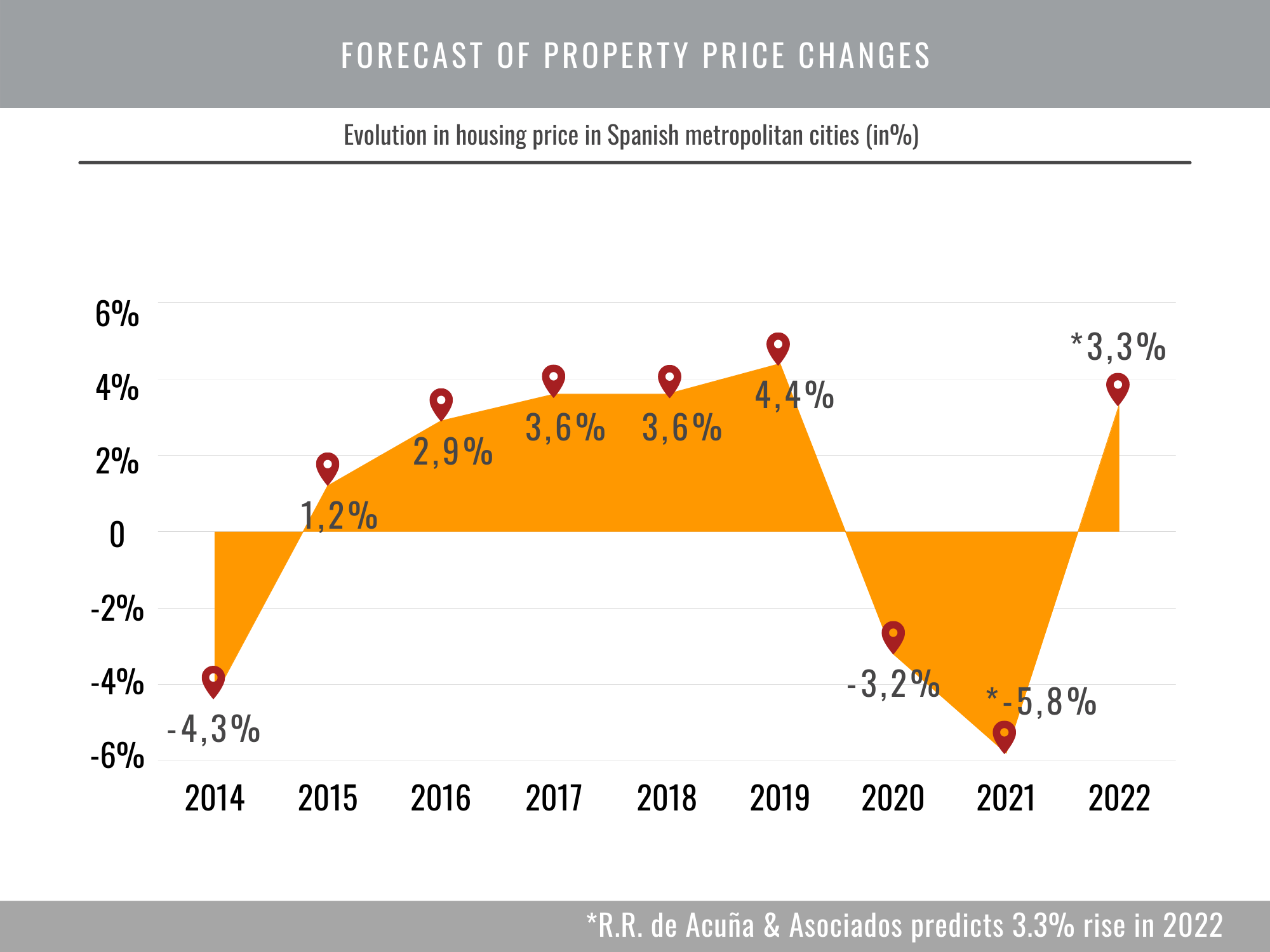
On a global scale, real estate prices are experiencing the most significant boom in the last two decades. In the US and Netherlands, prices are growing by 15%, and the share of countries with rising prices is at its maximum since 2000. For OECD countries overall, nominal housing price growth exceeds 8%. Thus, globally oriented real estate investment funds are providing high returns.
In Spain, real estate prices slowed during the pandemic and stabilized, which contrasts sharply with many other countries. In fact, the latest data for Madrid and Barcelona showed a decline of 1.5%. This is quite an unusual situation, considering that housing prices in Spain tend to be more volatile than in other regions. However, it’s hard to believe that low deposit yields and low-risk assets, as well as increased risks in stock markets, won’t bring investors back to the housing sector, although the geography of price growth may change as demand shifts after the pandemic.
On the other hand, rental yields have also significantly decreased in key markets (Madrid and Barcelona). Data for the first half of 2021 records a 10% drop. This effect has reduced gross rental yields, which are at minimum levels in recent years. Nevertheless, in Madrid it reaches 6.2%, in Barcelona — 5.8%, and in smaller cities (Zaragoza, Valencia, Seville, Malaga) it exceeds 7%. This yield clearly outperforms other types of assets and will continue to attract investments, which are necessary given the high demand for rental housing with limited supply. However, during the pandemic, the share of housing investors in large cities decreased, especially in Barcelona — from 30% to a modest 16%.
Obviously, the key factor in this situation is growing legal uncertainty. Catalan legislation changes frequently, and it’s unclear whether it will ultimately be applied. Moreover, the “okupas” movement has turned Catalonia into a hotspot for such activity, where organized mafia structures easily find a source of income. It’s hard to find a factor more harmful to investments than legal uncertainty. Throughout Spain, it’s still unclear what regulation will be adopted under the new housing law, which doesn’t contribute to making investment decisions to increase the rental housing stock.
In summary: the Spanish residential real estate market will continue to remain an attractive investment opportunity, as interest rates are expected to remain very low for an extended period. However, legal uncertainty and unpredictability of future rental market regulation limit the attractiveness of this type of asset in Spain.