Guide to getting Spanish residency
Contents
How to get Spanish residency
Registering as a resident
Long-term Spanish residence visa
Permanent residence (PR) in Spain
How to get Spanish citizenship
Brexit and residency in Spain
Conclusion
1. How to get Spanish residency
For EU/EEA/Swiss citizens: Citizens of these countries can stay in Spain for up to three months without formal procedures. For longer stays, registration with the local town hall is required, obtaining an NIE (Número de Identidad de Extranjero — foreigner identification number) and foreigner’s card. EU citizens do not require visas or work permits for permanent residence, although this affects access to social services.
For US citizens and other non-EU countries: Americans can enter Spain visa-free for up to 90 days for tourist or business purposes. For long-term stays, it’s necessary to apply for a residence permit. A complete list of visa-free countries is available through Spain’s official consular channels.
Types of residence permits:
Temporary residence (residencia temporal): valid, typically, for one year, with possibility of renewal, with or without work rights
Permanent residence (residencia permanente): issued after 5 years of legal residence
Spanish citizenship (nacionalidad española): requires 10 years of legal residence (or shorter periods under certain circumstances)
2. Registering as a resident

Registration deadlines: Non-EU citizens must register within 30 days of arrival when staying over 90 days. EU citizens are recommended to register as soon as possible to avoid long queues in major cities.
Registration conditions for EU/EEA/Swiss citizens: Registration is possible if the applicant:
Is an employee or self-employed in Spain
Has sufficient resources for themselves and family members not to become a burden on the social assistance system
Is enrolled in a recognized educational institution (at least 20 hours per week)
Is a family member accompanying an EU/EEA citizen
Spanish residence card (Tarjeta de Residencia)
A plastic card confirming residence permit status. To obtain it, you need to:
- Book an appointment online at sede.administracionespublicas.gob.es
- Choose the province and “Certificados UE” section
- Specify the basis: work, sufficient means, study, or entrepreneurship
Required documents:
Passport with valid residence visa. With long queues, situations may arise where the visa expires by the appointment time. In this case, it’s necessary to document that the appointment was made during the visa’s validity period.
2 passport-size photos
Signed rental contract or property registry extract (nota simple), if you own property in Spain
Certificado de empadronamiento (certificate of registration at place of residence)
NIE, if already obtained
Completed application form EX-17/18 (depending on citizenship) or EX-19 (for family members of EU citizens)
Proof of sufficient funds (minimum €7,000 per person). Accepted: bank statement for the last 3 months, employment contract, pension certificate.
Insurance or form S1
When submitting documents, a fee payment receipt is issued. Payment confirmation is presented when collecting the card.
Requirements may vary depending on the Spanish region. It’s recommended to have originals and certified translations of all documents prepared for obtaining the residence visa.
Foreigner identification number (NIE)
What is NIE: NIE (Número de Identidad de Extranjero) — a mandatory identification number for any financial and legal operations in Spain: opening bank accounts, filing tax returns, obtaining a driver’s license, etc.
Access and requirements: Only NIE holders can use the Spanish healthcare system, apply for pensions, subsidies, and unemployment benefits. According to Article 58 of the Foreigners’ Law (Ley de Extranjería), all foreigners conducting financial activities in Spain must obtain an NIE, regardless of EU citizenship.
Registration at place of residence (padrón / empadronamiento)

Purpose: Padrón — official certificate of registration at place of residence. Determines municipal funding and is necessary for:
Enrolling children in school
Hospital registration
Vehicle registration and obtaining Spanish license plates
Car purchase
Processing procedure: You need to contact the town hall (Ayuntamiento) with documents:
Passport
Utility bills (latest)
Copy of property certificate or rental agreement
NIE certificate
The procedure takes about an hour. Some municipalities charge a fee. The certificate is valid for 90 days and may require renewal upon request from hospitals, traffic police, or social services.
Documents
Foreign public documents must be legalized in one of the following ways:
Legalization through the Spanish Consular Department with jurisdiction in the document-issuing country, OR
Apostille in accordance with The Hague Convention of October 5, 1961
Documents requiring legalization: Birth certificates, criminal record certificates, diplomas, and marriage certificates must be apostilled and translated by a sworn translator (traductor jurado). The process can take up to six months — plan ahead.
3. Long-term Spanish residence visa
All citizens without Spanish citizenship staying over 90 days must obtain a residence permit. Permits are issued with or without work rights, as well as for special purposes (study). After 5 years with a residence permit, you can apply for PR.
Work and business visas
Work visa: Foreign workers officially employed in Spain receive residence permits based on employment contracts. Non-EU/EEA/Swiss citizens must find work before applying and compete with EU workers, although specialists in shortage professions may find vacancies faster.
The employment contract must contain employer details, salary amount, and validity period. Foreigners legally residing in Spain for 3 years on a student permit or 1 year on a permit without work rights can transition to a work permit provided the net salary exceeds the industry average and amounts to at least €900 per month (2019 rate).
The work permit provides access to the Spanish social security system (Seguridad Social) and healthcare (CAT Salut) for taxpayers.
Business visa: Under Law 14/2013, foreign entrepreneurs can obtain residence permits for innovative or strategically important businesses. Requirements:
Business plan demonstrating economic benefit to Spain
Proof of funds (minimum €900 per person per year)
No mandatory minimum investment (unlike Golden Visa)
Company registration documents
Also suitable for highly qualified specialists, researchers, and employees of multinational companies transferred to Spain. Approval depends on the Ministry of Economy in Madrid. A nominally operating company is insufficient — the project must demonstrate real economic value.
Student visa
Validity and renewal: The initial visa is valid for three months. Upon arrival, the student must apply for a student permit within one month and obtain a tarjeta de estudiante (student card).
Benefits:
Right to work up to 4 hours per day
Permit renewal without leaving Spain
Access to bicycle sharing system (bicing)
Free movement within the Schengen Area
The student permit is issued for a maximum of one academic year and renewed upon continuing education. Time on a student permit doesn’t count toward PR eligibility, however after 3 years on a student permit, transition to a work permit is possible.
Documents: Proof of enrollment (Matrícula) from the educational institution must be provided.
Spouse visa and family reunification
Those entitled to reunification:
Spouse
Minor children and spouse’s children, including adopted ones, provided they are dependents of the applicant and haven’t yet formed their own family
Family members unable to care for themselves due to health conditions
Parents of the applicant and spouse’s parents, financially dependent on the applicant, over 65 years old, with accommodation in Spain

Income requirements: When simultaneously applying for spouse and minor children, additional annual income of €1,500 per family member beyond basic requirements must be confirmed. Documents confirming relationships are mandatory.
Pension visa (Pensionado)
Conditions: Foreign pensioners (from 65 years) can obtain residence permits with unlimited renewal rights. Requirements:
Guaranteed pension of at least €900 per month (2019 minimum)
Own or rented accommodation in Spain
No criminal record
No immigration violations
Financial requirements may vary depending on the city’s police department — it’s recommended to verify at the intended place of residence. EU citizens must have form S1 for access to Spanish public healthcare.
Medical visa
Visa type: Non-EU citizens receive tourist visas (90-day validity) for medical treatment; EU citizens don’t require visas for medical stays.
Required documents:
Passport
Insurance or form S1
Flight tickets
Confirmation of prepaid treatment
Doctor’s appointment letter
Clinic confirmation of paid stay
To extend the visa, contact immigration services with documents:
Official form EX-00
Passport
Financial report
Insurance or form S1
Return tickets to country of origin
Statement indicating exceptional reasons for extension
Note: all foreign documents must be translated into Spanish or the regional official language.
Healthcare: Foreign workers or pensioners not working in Spain must purchase private insurance, as Spain’s social security system doesn’t cover them. Access to public healthcare requires an employment contract or pension status.
Investor visa (Golden Visa)
The 2013 law introduced an accelerated procedure for obtaining residence permits for real estate investors. Minimum investment amount: €500,000 for property purchase. The right to a permit extends to the applicant and family members. Details are covered in a separate article.
Residence without work rights (Non-Lucrative / Residencia no lucrativa)
Purpose: Intended for non-EU citizens with independent income who don’t work or study in Spain.
Main benefits:
No mandatory investment required
Residence permit for the entire family
No language requirement
Path to citizenship after 10 years
Financial requirements:
| Requirement | Amount |
|---|---|
| Monthly income | €2,200 (main applicant) + €540 per family member |
| Funds in Spanish bank | €28,000 (main applicant) + €7,000 per family member |
| Housing | Rent (from 24 months) or purchase |
Family members eligible for inclusion: Spouse, children under 18, dependent adult children, fully dependent parents.
Validity period: One year initially, then two-year renewals; PR after 5 years.
Stay requirements: Minimum 183 days per year in Spain.
Flexibility: After one year, transition to regular residence permit with work rights is possible.
4. Permanent residence (PR) in Spain
Deadlines and requirements: 5 years of legal residence with continuous social security contributions required. Must be in Spain at least six months per year.
Validity period: 5-year permit with residence and work rights equal to Spanish citizens.
Work rights: Both self-employment (por cuenta propia) and employment (por cuenta ajena) are permitted.
Benefits:
Free movement within the EU without stay restrictions
University education at local student rates (Home Student)
Work rights for applicant and family members
Basis for citizenship application
Stable developed European economy
Main requirements:
5 years of continuous residence in Spain
No criminal record in Spain
Medical insurance or form S1
Proof of sufficient means of subsistence
Maximum absence: six months per year
Absence limitations: The applicant must not be absent outside the EU for more than 12 consecutive months or outside Spain for more than six years. For prolonged absence, a permit restoration procedure is provided.
Required documents (form EX-11):
Passport and copies of all pages
Receipt of state fee payment
Criminal record certificates (from country of origin and Spanish authorities)
Proof of continuous residence issued by municipal authorities
Periods of residence under EU Blue Card (if applicable)
Documents on pension rights in Spain
Birth certificate or proof of residence in Spain
Documents on guardianship by Spanish organization (if applicable)
Documents on loss of Spanish citizenship (if applicable)
Documents on refugee status or preferential status (if applicable)

For parents:
Child’s birth certificate or other identity document
Report from educational organization about school-age child enrollment
All foreign documents must be translated into Spanish, apostilled and, if necessary, consularly legalized.
5. How to get Spanish citizenship
Residence period requirements:
General rule for all citizens: 10 years
For persons recognized as refugees in Spain: 5 years
For citizens of Latin American countries, Philippines, Equatorial Guinea, Andorra or Portugal: 2 years
For persons married to Spanish citizens, or born in Spain: 1 year
Benefits of citizenship:
All EU citizen rights protected by European Union laws: freedom of residence, study, work and business in any EU country
Free movement within the EU without restrictions
Work rights and all rights equal to Spanish citizens
Safekeeping of funds in reliable European banks
Right to participate in Spanish state activities
Simplified procedure for inviting relatives and family reunification
Citizenship by residence
Applicants with any valid residence permit for 10 or more years can apply for citizenship. Documents undergo judicial review, often with interviews — sometimes repeated. Spouses of married applicants are also called for interviews. The decision arrives by mail.
By origin or birth
Right to citizenship (Spanish Civil Code, Article 17):
Children born to Spanish parents
Children of foreign parents born in Spain, if at least one parent was born in Spain (except children of diplomats)
Those born in Spain can apply after one year of legal residence.
Marriage
Requirements:
Legal marriage to a Spanish citizen
One year of continuous legal residence
No divorce at time of application
No signs of fictitious marriage
Document requirements and deadlines vary by province. Before marriage, interviews may be conducted to verify relationship authenticity.
Widows and widowers: Widows and widowers of Spanish citizens have the right to citizenship provided the marriage lasted until the spouse’s death.
Obtaining citizenship and Spanish passport
Application procedure:
Achieving the required residence period (10 years / 5 years / 2 years / 1 year — depending on category)
Submitting complete document package in Spain
Passing mandatory state exam
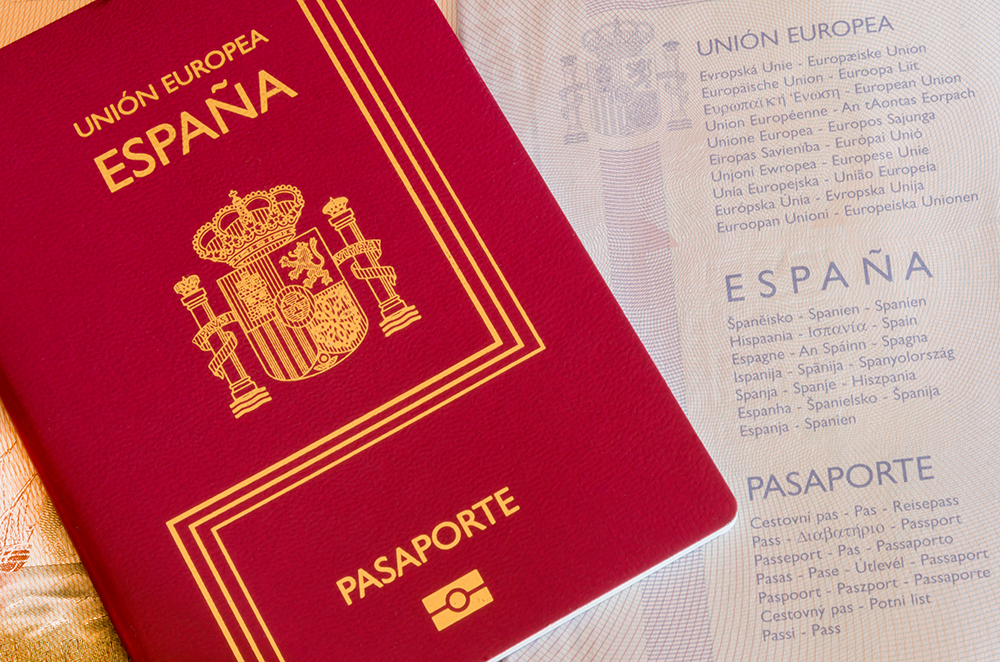
Obtaining Spanish passport
Mandatory exam: Since October 2015, applicants must pass the CCSE exam (Conocimientos Constitucionales y Socioculturales de España), conducted by the Cervantes Institute. The test includes 25 multiple-choice questions across five thematic blocks: state structure, legislation and citizenship, culture, history and Spanish society. Time: 45 minutes.
Exams are conducted at accredited centers worldwide (list on the Cervantes Institute website). Minors and persons declared incapacitated are exempt from the exam. Waiting can be up to six months.
Required documents: The document list varies significantly by region. Exact requirements should be verified with immigration services.
Approximate general list:
For obtaining by residence (10+ years):
Residence card (tarjeta de residencia / tarjeta de residencia y trabajo), EU citizen ID card or certificate from Central Foreigners Registry
Passport
Updated birth certificate
Criminal record certificates (from country of origin and Spanish authorities)
Registration certificate (empadronamiento) — requested from town hall (Ayuntamiento)
Income confirmation: employment contract
Last three payslips (nóminas) with originals
Tax return (declaración de renta)
Certificate of social security fund contributions (certificado de vida laboral)
NIE
Additionally for spouses of Spanish citizens:
Updated spouse’s birth certificate (Certificado lateral de nacimiento de esposa/o — actualizado)
Updated marriage certificate registered in Spain (Certificado lateral de matrimonio — actualizado e inscrito en España)
Updated cohabitation certificate from town hall (Certificado de convivencia ayuntamiento — actualizado)
For children of Spanish citizens:
- Ancestors’ birth certificates
Required exams:
DELE (Spanish language proficiency, minimum A2 level) — not required if you have a previously obtained A2 level certificate or higher
CCSE (Spanish culture, politics, history)
Cost:
Application filing fee: up to €100
Payment for two exams: €125 + €85
Document legalization and translation: about €350
Legal assistance (recommended for complex cases): may amount to several thousand euros
Processing time: Maximum 12 months (according to regulations of November 7, 2015). No response after 12 months means rejection.
Dual citizenship in Spain
Countries with which dual citizenship is allowed: Portugal, Andorra, Philippines, Equatorial Guinea and Latin American countries.
Other countries: Applicants must renounce previous citizenship to obtain Spanish citizenship.
In practice: Many retain their former country’s passport alongside Spanish citizenship, however Spain reserves the right to revoke Spanish citizenship for violating relevant legislation.
6. Brexit and residency in Spain
Current situation (as of September 25, 2019): British citizens in Spain won’t face changes if Britain provides similar rights to Spanish citizens in England. About 366,000 British citizens live in Spain, while approximately 180,000 Spaniards live in Britain.
Most likely scenario: British residents will transition from European cards to residence cards for third-country nationals. Document requirements will remain virtually unchanged.
Recommended actions before Brexit:
Get registration: if you don’t have certificado de registro de ciudadano de la unión or NIE in Spain, obtain them while the procedure for European citizens is simpler and faster.
Apply for PR: if you’ve lived in Spain for 5 years, apply for permanent residence before Brexit, as it’s unknown how simple the procedure will be after Britain’s EU exit.
7. Conclusion
The path to Spanish citizenship typically begins with a residence permit based on property purchase or employment. Permit renewal and obtaining PR require compliance with basic conditions (property, income) over 10 years of continuous residence. In most cases, dual citizenship involves renouncing the previous one — exceptions apply to certain countries. British citizens are recommended to obtain PR before Brexit takes effect.