Costs of selling property in Spain
Contents
How much will the seller spend?
Land value increment tax (Plusvalía)
Capital gains tax on your profit (IRPF)
Income tax withholding – Retención
IBI or municipal property tax
Banking fees
Agency commission
Energy certificate
Foreign residents aged 65 and older
Sale of mortgaged property
Other expenses
Conclusion
1. How much will the seller spend?

When buying or selling real estate, it’s important to consider all associated costs. The buyer spends 8–15% on transaction processing.
RESALE PROPERTY — Seller’s expenses:
- Agency commission (5–10%)
- Capital gains tax IRPF (19%–23%)
- Income tax withholding Retención (3%, only for non-residents)
- Land value increment tax Plusvalía (200–600 euros)
- Energy certificate (100–600 euros)
- If there’s a mortgage: property appraisal + banking fees + insurance (200–1,500 euros for appraisal + 1% commission + 500 euros insurance)
NEW CONSTRUCTION — Buyer’s expenses:
- VAT IVA (10%)
- Stamp duty IAJD (0.1–2%)
2. Land value increment tax (Plusvalía)
This is the most important tax when selling real estate. It’s calculated as a percentage of the difference between the original land cost and the sale price.
What is the size of the land value increment tax in Spain?
The tax is based on the cadastral value of the land at the time of sale and the period of ownership of the property. It compensates the municipality for the difference in land value during the ownership period.
How to calculate this tax when selling real estate?
Factors for calculation:
Cadastral value of the land where the property is located. This can be found in the last IBI tax payment receipt or directly at the cadastral office (Catastro).
Period of ownership of this property by the seller, starting from the purchase date and ending with the sale date.
Tax rate, which depends on the location of the property, as each municipality in Spain has its own rate. This information can be found on the municipality’s official website or at city hall. The maximum rate in this case is approximately 30%.
Growth coefficient or revaluation tax. These two components of the land value increment tax calculation base also depend on the location of the property. This information can be obtained at city hall or the cadastral service. The maximum is approximately 3.5%.
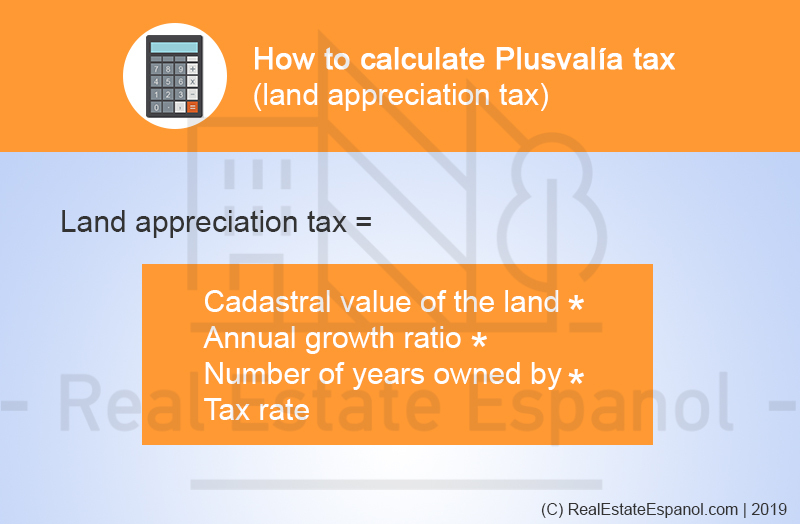
Formula: Cadastral value × Annual growth coefficient × Ownership period × Tax rate = Plusvalía
The maximum considered period is 20 years. If less than a year has passed since purchase, Plusvalía tax is not paid, but filing a declaration is mandatory.
Example: house bought 10 years ago, cadastral value €200,000, growth coefficient 3.5%, tax rate 30%: €200,000 × 3.5% × 10 × 30% = €21,000
3. Capital gains tax on your profit (IRPF)
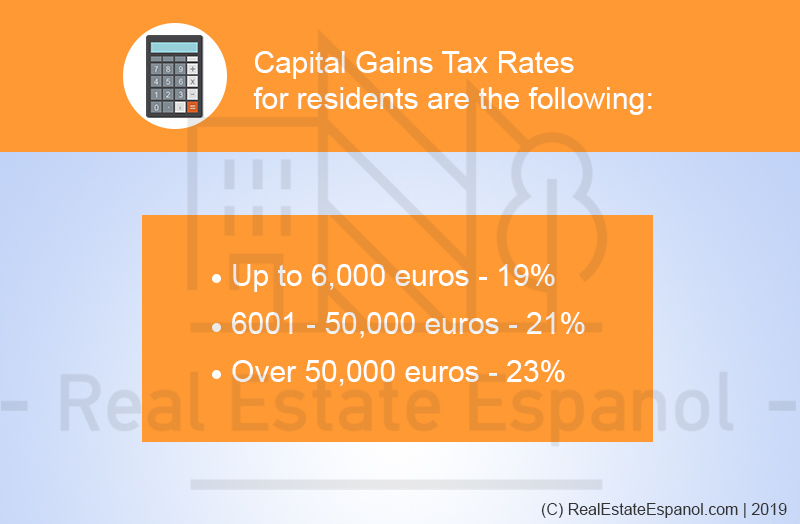
Tax on the difference between the purchase price and the sale price. Persons who bought real estate before December 1986 are exempt from this tax.
Non-residents: fixed rate of 19%.
Residents: must confirm resident status (tax declarations for 3 years, deed of sale dated 3+ years, or certificate from city hall for 3 years).
How to avoid capital gains tax when selling real estate in Spain
Deduct from the IRPF base the expenses from invoices for repairs and agency commission.
For Spanish residents: report income in the declaration for the following year. If within 2 years all proceeds are spent on purchasing new primary housing in EU/EEA, no tax is charged.
If market price has fallen, you can apply for tax refund.
4. Income tax withholding – Retención
Withholding of 3% from the transaction amount when selling by non-residents to cover possible capital gains tax. Applies only to fiscal non-residents.
Residency is confirmed exclusively by a certificate from the tax office (not NIE card or residence card). The certificate is issued after several years of filing tax returns.
If capital gains are not confirmed, the seller can apply for a refund of withheld funds. There are 3 months to file the application, waiting for refund is 1–2 years.
If you continue to live in Spain: provide a rental agreement for 6 months or more, or a purchase-sale agreement for new housing. Apply for a certificate of exemption from withholding.
5. IBI or municipal property tax
The seller pays IBI for the year of sale (the taxpayer is considered the owner on January 1). Example: sale on December 1, 2017 — seller pays IBI for 2017, buyer for 2018.
This is an annual municipal property tax calculated based on cadastral value. Cadastral value is often several times lower than market value. Average tax amount is 200–800 euros per year. IBI rate varies from 0.4% to 1.2%.
6. Banking fees

If you don’t have a bank account in Spain, you need to open one.
When transferring money abroad, banking fees and exchange rates can be quite significant. Use specialized transfer services or brokerage companies. Check for FCA license.
7. Agency commission
What is the commission amount?
Usually commission is 5–10%. Exception: in Malaga and Valencia, commission is not included in the seller’s price — it’s paid by the buyer and amounts to 3%.
VAT (IVA) of 21% is charged on the agency commission from the service cost.
8. Energy certificate

Mandatory since June 1, 2013. Issued by surveyors, architects, or civil engineers.
Apartment: €100–200. Villa: €200–500. Penalty for missing certificate: €300–€6,000.
Request an invoice to deduct these expenses from capital gains tax.
9. Foreign residents aged 65 and older
Exempt from capital gains tax provided they have legally resided in Spain for 3+ years and are selling their primary residence.
If you’re returning to your country of origin: pay the 3% withholding, then apply for refund along with the declaration for the following year.
If you don’t pay taxes in Spain but your annual income doesn’t exceed €11,200, you’re exempt from IRPF.
Way to avoid tax: arrange a life annuity (renta vitalicia) and reinvest up to €240,000.
10. Sale of mortgaged property
You must remove the mortgage encumbrance from the property registry, even if the loan is fully paid off. Costs for canceling the mortgage record: up to €1,000 (notary + registry).
If there are current obligations: pay off the mortgage. The bank charges an early repayment fee of 0.5–1% of the loan amount.
Get the house in order. Evaluate whether it’s profitable to include furniture in the price.
11. Other expenses
Utility bills and service charges
All bills must be paid. Provide the notary and buyer with a community of owners certificate (Certificado de Comunidad, cost ~€20).
Property advertising
Remember that premium ad placement is not free, but it allows your property to be at the top of catalogs.
It’s strongly recommended to hire a professional photographer so your photos are bright and high-quality.
Double deposit
When concluding a private purchase-sale agreement: if the seller refuses the deal, the buyer receives double the deposit amount. If the buyer refuses — they lose the deposit.
12. Conclusion
In Spain, real estate tax rates are among the lowest compared to other EU countries.
Documents required for sale:
Title documents (Título de propiedad/Escritura de compraventa or their copies). If the property belongs to a company, provide powers of attorney from all authorized company members/co-founders.
If there was a mortgage — certificate of outstanding debt and registry cancellation (Certificado de deuda pendiente y Cancelación Registral), confirming removal of all mortgage obligations from the property.
Nota simple (registry extract).
Certificate of habitability (La Cédula de habitabilidad).
Receipts for IBI payment, IRPF (income tax for non-residents), Basura (garbage collection fee).
Paid utility bills (their copies).
Community of owners certificate (Certificado de Comunidad).
Community of owners bylaws (Estatutos de la Comunidad de propietarios, if applicable).
Energy certificate.
List of furniture and appliances included in the price.
Your passport, DNI, residence card (if applicable).
NIE (foreigner identification number).
Advantages of direct sale
If you decide to sell the house yourself, you’ll get more profit by saving on the commission percentage that real estate agencies take.
With direct sale, you can act according to your own preferences regarding where and how to advertise the property.
You’ll have direct contact with the buyer. This can be a great advantage as it helps avoid misunderstandings, and if they arise — quickly resolve them. As a result, contract negotiations will proceed faster.
You know your house better than anyone. If your house has any positive features worth highlighting, however minor they may be, you know them best and can tell potential buyers about them. Sometimes it’s the small details that make the purchase decision positive.
Disadvantages of direct sale
Keep in mind that this will take a lot of time and effort. You’ll have to handle promotion, showings, and convincing clients yourself. Don’t forget about paperwork!
It’s not easy to find good specialists at each stage you’ll need to go through, while agencies offer full service with their proven lawyers, translators, notaries, etc.
You may not know the current real estate market situation and sell your house either too cheaply or not sell at all due to an inflated price.
You may miss important points concerning the entire procedure and especially the legal aspect, which will lead to problems and additional time and effort costs.
Advantages of selling through an agency
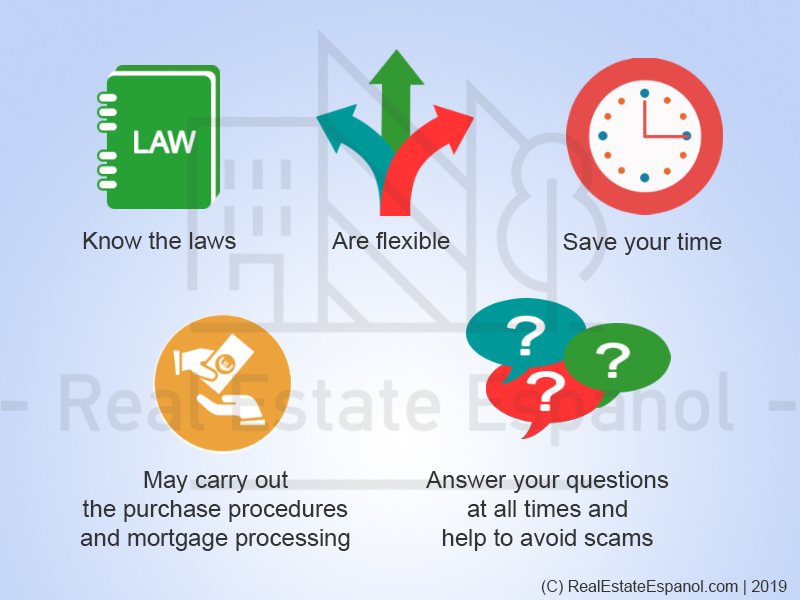
A real estate agent knows how to find potential clients. They’re usually experienced and have certain tools and knowledge to make the process go smoothly. For example, they can show the client other options for comparison with your property to make it look most advantageous. With such information, it’s much easier for the buyer to make the right decision.
Conscientious agents will always answer your questions and help avoid possible fraudulent schemes.
Agents can inform you about the most common market conditions and prices for the type of property you’re selling. This will help avoid selling the house at an undervalued price or setting a price at which selling the property will be practically impossible.
Real estate agents know the laws related to home sales. This will help avoid contract mistakes that could become a problem in the future.
Agents organize visits themselves. This is their job, so they have more flexibility than owners for visiting the property with buyers. Thus, this helps save time and sell faster.
Agencies can take on purchase and mortgage procedures. Usually they offer this as an additional option for a separate fee.
Agents know how to improve your home’s appearance. For example, it’s recommended that when selling, the house should have as little decor as possible, the interior should be neutral and simple, without personal portraits or owner’s belongings.
Disadvantages of selling through an agency
You’ll have to pay a commission, causing you to lose 5–10% of the property price.
The agency decides how and where to advertise your property, and you can’t always influence this.
The agency may be inclined to inflate prices on apartments or houses to get greater benefit. Therefore, it’s important to consider this and navigate prices.
There’s a risk of encountering scammers. Since licensing of real estate agencies in Spain is not mandatory, you can check them by formal signs: having an office, staff, reviews, membership in professional agent associations such as AIPP, API in Catalonia, LPA, GIPE. Overall, we advise acting through a lawyer. Their services will include all checks and guarantees.