Spanish Property Market 2020
Contents
Will residential and commercial real estate prices continue to rise? Let’s take a closer look at Spain’s real estate market in the near term.
Spain’s real estate market in 2020 [updated after Covid-19 quarantine]
Spain’s real estate market in 2019
Expert opinions on Spain’s real estate market. Trends
Current real estate prices in Spain
Spain real estate price forecast for 2020
Spain’s real estate market after Brexit
Conclusion
Are we facing another real estate bubble? Is it better to buy now or wait? Will real estate prices in Spain fall in 2020? 2019 was marked by a slowdown in Spain’s housing market. Neither purchase volumes, nor prices, nor construction rates grew as they had in previous years. Given the fragmented nature of the market, we will examine in detail those regions of Spain that are of interest to foreign buyers.
1. Spain’s real estate market in 2020 [updated after Covid-19 quarantine]
In February 2020, the Covid-19 coronavirus epidemic began, and Spain became one of the most affected countries (as of early June 2020, more than 27 thousand deaths are known). For approximately three months, the country’s economy in general and the real estate market in particular were almost completely paralyzed.
It can be said that the real estate industry is now trying to “find itself” in the post-quarantine world. According to specialists from one of Spain’s leading banks, Bankinter, most potential buyers will postpone their transactions for 6-12 months, which means a significant drop in sales is expected this year.
Experts are confident that in 2020, Spanish housing will begin to cheapen against the backdrop of declining demand. The question is only how much and for how long. Thus, Carlos Ruiz, director of the Institute for Economic Research of Spain, believes that the cost of local housing will decrease proportionally to the overall GDP losses in 2020 — that is, by 5-10%. The most optimistic forecast is given by S&P Global Ratings analysts: they predict -3.5% in 2020 and a return to price growth starting from 2022.
The Spanish division of Engel & Völkers is much more pessimistic: experts expect price declines of 9-20% by the end of the year. A similar forecast comes from the Department of Economic Theory at the University of Barcelona. Professor of Economics Gonzalo Bernardos believes that Spanish houses and apartments will lose about 13% of their value this year. The market will finally be able to return to “pre-quarantine” positions no earlier than 2023.
Speaking about what has already happened in the Spanish real estate market, it’s worth noting: at the moment, the pandemic has not yet managed to significantly impact price trends. Most likely, significant changes, if they manifest, will only become noticeable in 6-12 months.
Currently, the situation looks as follows (as of June 2020): the average cost per square meter of housing in Spain is €1,730/m², which is 1% more than in June 2019. The cost per square meter of rental housing is €11.4/m², which is 4% more than in June 2019.
Cost per square meter of housing in June 2020
- Balearic Islands — €3,105/m² (+4.2% per year)
- Madrid — €2,783/m² (-1.4% per year)
- Basque Country — €2,597/m² (+1.4% per year)
- Catalonia — €2,226/m² (+0.1% per year)
- Canary Islands — €1,854/m² (+3.2% per year)
- Andalusia (Costa del Sol) — €1,646/m² (+6% per year)
- Alicante Province — €1,596/m² (+3.8% per year)
2. Spain’s real estate market in 2019
Although home sales grew by 1.8% in December 2019 compared to December 2018, the year ended with an annual decline of 3.3% — the first drop since 2013, barely exceeding half a million transactions. Nevertheless, sales exceeded the 500,000 transaction mark for the second consecutive year since 2008.
Secondary real estate transactions decreased by 4.2% year-on-year, interrupting a series of six consecutive years of growth. At the same time, new construction operations grew by 1.2% — the best performance since 2014 — and continued a three-year trend of positive growth. However, only 18.5% of sold properties were new housing, while 81.5% were secondary.
Foreign buyer activity in the Spanish real estate market also decreased somewhat in 2019 compared to 2018: from more than 65,400 operations in 2018 to 63,000 transactions last year (-3.7%). The share of housing purchases by foreigners in 2019 was 12.5% of the total number of transactions (503,875 properties, -2.5% compared to 2018).
The Valencian Community (27.1%), Canary Islands (25.3%), and Murcia (18.6%) were the most sought-after regions in the last quarter of 2019. British, French, and Germans remain the main foreign buyers. However, the share of British in total transactions continues to decline since the Brexit announcement.
As usual, Spain’s coastal provinces are in greatest demand among foreigners. Alicante (42.3%), Balearic Islands (35.1%), Santa Cruz de Tenerife (30.7%), Girona (28.3%), Malaga (27.2%), and Las Palmas (20.4%) were the places of greatest interest by year-end.
In 2019, housing prices showed growth of 7.2%, but are still 11.9% below the absolute maximum of 2007. This figure also contrasts with price growth in 2018, which was around 10%.
3. Expert opinions on Spain’s real estate market. Trends

“We expect continued slowdown in the housing market in 2020 — in sales volumes, prices, and new construction.” — Rafael Gil Moreno, research director at Tinsa
Thus, he foresees “exhaustion of the expansive cycle” in this market, which he relates to the economic situation.
What is causing the growth slowdown? On one hand — the maturity of the cycle that the sector is entering throughout Europe, on the other — difficulties in housing access after price growth in recent years. In other words, since supply does not cover demand in certain areas of Spain, such as the metropolitan areas of Madrid or Barcelona, this pulls prices up. But at the same time, being too expensive, the market slows down due to accessibility problems, and as a result, growth is hindered.
Are we approaching another crisis?
So far, practically no one sees an approaching economic crisis. “We are quite far from entering a new recession in the real estate sector,” summarizes Arturo Diaz, executive director of the residential division at Savills Aguirre Newman. In his opinion, the Spanish market has reached a “stable phase with moderate price growth and quite decent sales rates.”
Nevertheless, a final forecast can be given no earlier than June 2020, when the impact of economic slowdown after the pandemic becomes obvious.
What innovations should we expect?
2020 will be key for technological development in the housing sector. Advances in home automation and smart systems have become the focus of some major sector companies.
Smart lockers for packages are an example, gaining popularity in large cities. In a world of online shopping, where every fourth home delivery fails due to people’s absence, this innovative system is a real solution. Such lockers are installed in common areas of buildings, and owners can open them with a simple code or app.
“Technology is revolutionizing and changing the sector. Sustainable development cannot be overlooked. In 2020, the European directive on building energy efficiency came into force, establishing that by year-end all new constructions must ensure almost zero energy consumption.” — Nuria Serranos, BNP Paribas
The CEO of Vía Célere also has an opinion related to another relatively new trend in the sector.
“We must continue working on industrialization of the construction process.” — Morales Plaza
4. Current real estate prices in Spain
Housing prices in Spain showed a decline of 0.3% in February, currently standing at €1,752 per square meter. However, if we compare the current price with February 2019, we see growth of 3.4% — according to the latest Idealista real estate price index.
By autonomous communities, the greatest price decline was recorded in Castile and León (-1.3%) and Catalonia (-0.7%), followed by Galicia (-0.4%), Andalusia (-0.3%), Aragon and Cantabria — both at -0.2%. Conversely, prices remained stable in the Balearic Islands, Valencian Community, Madrid, and Navarre.
The opposite situation is in Extremadura, where growth of 1.6% was recorded, followed by the Canary Islands (0.6%), La Rioja and Murcia — both with 0.5% growth.
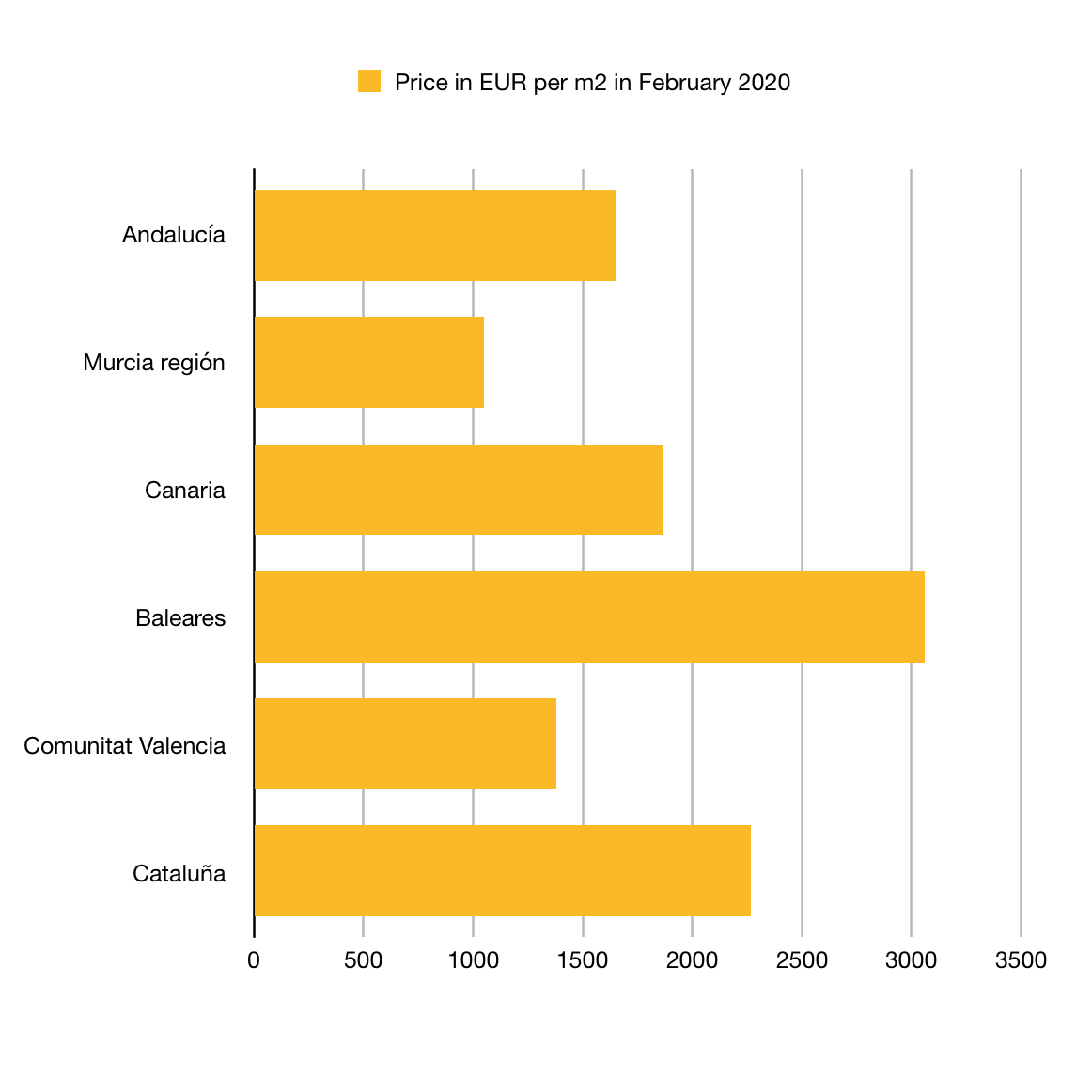
The Balearic Islands are the most expensive autonomous community with a price of €3,060 per square meter, followed by Madrid (€2,796) and the Basque Country (€2,576). The cheapest are Castile-La Mancha (€868), Extremadura (€902), and Murcia (€1,051).
San Sebastián again became Spain’s most expensive city with a current real estate price of €4,545, followed by Barcelona (€4,104) and Madrid (€3,725).
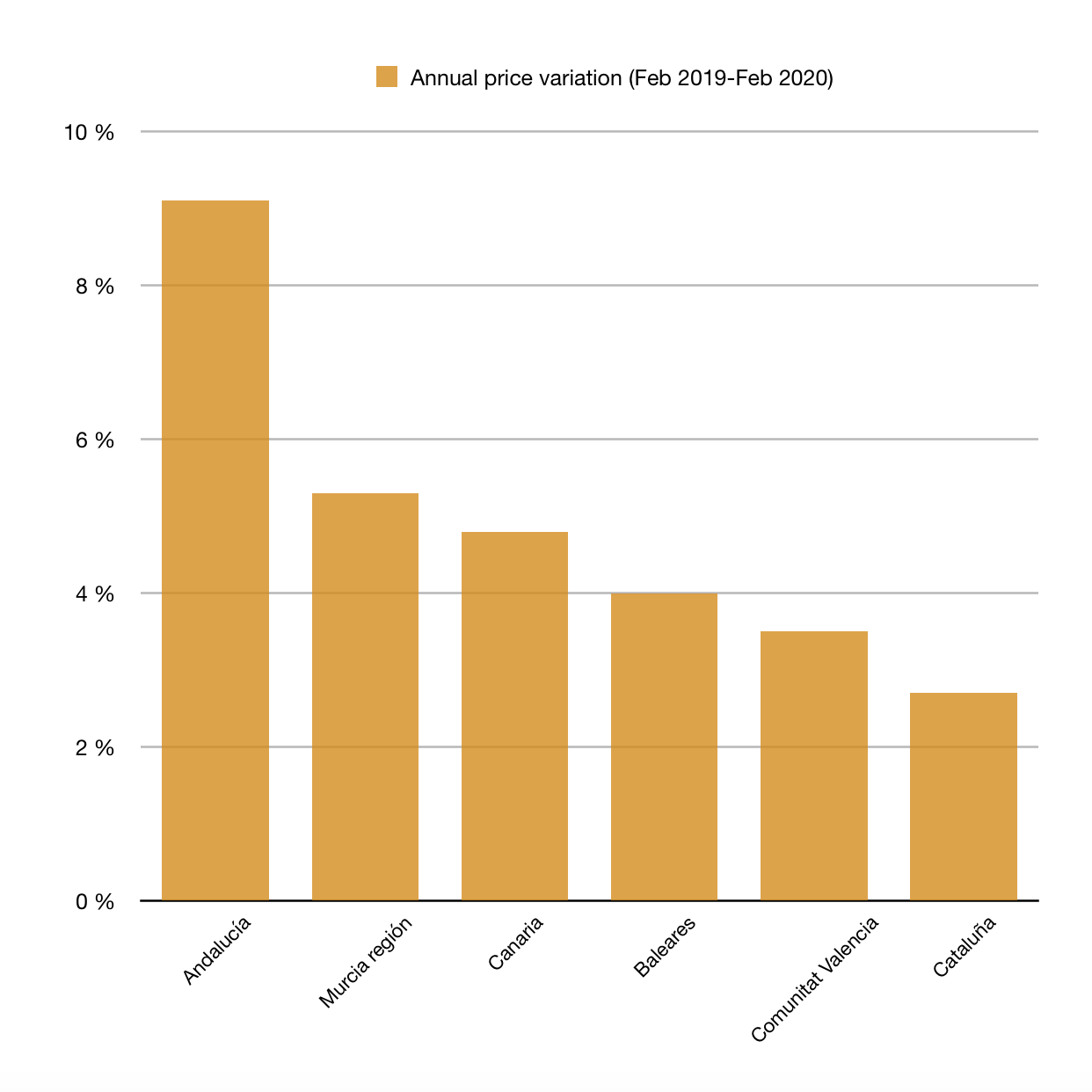
Price per m² and annual change for all regions of Spain:
| Region | Price per m² (February 2020) | Annual change |
|---|---|---|
| Andalusia | 1,652 | 9.1% |
| Region of Murcia | 1,051 | 5.3% |
| Canary Islands | 1,863 | 4.8% |
| Balearic Islands | 3,060 | 4.0% |
| Valencian Community | 1,381 | 3.5% |
| Catalonia | 2,268 | 2.7% |
| Aragon | 1,325 | 2.5% |
| Basque Country | 2,576 | 1.5% |
| Madrid (community) | 2,796 | 1.4% |
| Melilla | 1,773 | 1.3% |
| Ceuta | 2,087 | 0.8% |
| La Rioja | 1,199 | 0.5% |
| Extremadura | 902 | -0.1% |
| Cantabria | 1,453 | -0.4% |
| Castile-La Mancha | 868 | -0.7% |
| Navarre | 1,413 | -1.3% |
| Castile and León | 1,146 | -1.3% |
| Asturias | 1,341 | -1.6% |
| Galicia | 1,356 | -1.9% |
However, despite the fact that average housing prices in most provinces are in the range of €900-1,250, there are still provinces such as Ciudad Real, Lugo, or Toledo, where housing prices do not exceed €660/m².
5. Spain real estate price forecast for 2020
Real estate portal Pisos.com believes that real estate prices will grow by 2-4% this year, while rental rates may rise by 4-6%.
Fotocasa gives a rather pessimistic forecast: in their opinion, real estate prices will grow by 1-2%. Rental costs will increase by 2.5%.
The Association of Builders and Developers (APCE), representing construction company employers, forecasts sales price growth of 3.5-5% in 2020.
Rating agency Moody’s suggests that Spain’s real estate market will become the most expensive housing market in Europe in 2020. They forecast real estate price growth in Spain of 5.5%.
Bankinter bank noted that sales prices will grow by 1-2% this year. Regarding the Euribor rate, they believe it will remain below zero, in the range of -0.27% to -0.17%.
Source: El País
Overall, all analysts providing specific figures point to a range of 2-6%. Thus, the housing buy-sell market in 2020 expects moderation or slowdown — both in prices and number of transactions.
6. Spain’s real estate market after Brexit

Brexit would become a turning point in foreign real estate purchases in Spain. The first reason is the devaluation of the pound sterling and, consequently, the higher cost of housing for British buyers. Additionally, some potential buyers from the UK have already decided to postpone their purchase decision until it becomes clearer what Brexit will bring them.
Individual segments of Spain’s housing market may face price declines. This concerns Costa del Sol, Costa Blanca, the Balearic and Canary Islands.
Among property types that may be most affected are apartments and private homes in beachfront urbanizations valued above €300,000.
Additionally, Britons may begin putting their real estate on the Spanish coast up for sale, increasing supply. This is already happening, but not yet on a large scale. Some experts forecast an alarming growth in supply. However, the market is not ready to absorb this volume, and such properties will become part of unsold housing stock in the medium and long term.
Others believe that British real estate could become an investment opportunity, as it will be listed below market price for quicker sale.
Uncertainty surrounds Brexit and Spain’s housing market. Spain and the UK have strong trade and demographic ties. These are more than sufficient grounds for both countries to sign bilateral agreements mitigating the consequences of the UK’s EU exit, including consequences for the real estate sector.
7. Conclusion
International corporations continue to consider entering the Spanish real estate market. It’s no coincidence that two giants — El Corte Inglés and Berkshire Hathaway HomeServices, owned by Warren Buffett — decided to simultaneously enter the market this year.
Spain’s homeownership market expects moderate prices and sales volumes in 2020. Experts emphasize that price fluctuations will continue to vary depending on geographical location, and note the housing affordability problem. Price growth for both purchase and rental will be smoothed out.
The effect of mortgage law, which slowed sales and mortgage lending in 2019, may begin to weaken. Now is a good time for rental, especially for young families. Essentially, price growth is slowing; rental rates are rising; bank interest rates are at historic lows; Euribor is negative.
After 2019 ended with more than 100,000 construction permits for the first time in 10 years, experts claim that secondary housing will continue to lead the market in the short term. As various studies show, new housing construction will continue to grow in 2020 — estimated at up to 94,000 new homes versus 79,000 in 2019. This represents 18.4% growth, indicating healthy sector development in this direction. Overall, experts believe that 2020 is an excellent year to buy and possibly not the best year to sell.
Although there are reasons for vigilance, there are no alarming signals, as factors that could most significantly affect the real estate sector remain fairly stable: sustainable employment growth, wage recovery, favorable financial conditions, stable demand, and housing construction volume.