Spanish Property Market 2021
Contents
Spanish real estate market in 2021
Property price changes compared to 2020
Spanish real estate market trends
Current property prices in Spain
Spanish property price forecast for 2021
1. Spanish real estate market in 2021
It seems last year opened a new path in the Spanish real estate market: high demand for rental housing, locals who no longer want to buy apartments in the city center, but are looking for townhouses in the suburbs.
Nevertheless, many believed that the pandemic would be a disaster for the real estate sector, so it’s no surprise that the discussion about whether housing prices would fall returned to the agenda. The pandemic added an additional dose of uncertainty to the market, which will continue to affect buyers, sellers and investors in 2021.
Regarding foreign buyers, after the positive effect of Covid-19 control measures and the recovery of European economies, experts forecast significant growth in housing sales to foreigners as early as summer 2021 — after a substantial decline last year.
According to Idealista, at the beginning of 2021, the average property cost in Spain is €1779/m². This is 0.9% higher than a year earlier. But how is this possible during a pandemic and closed borders? Let’s figure it out.
2. Property price changes compared to 2020

The listed trends combined with other factors led to local real estate not only maintaining its position during the pandemic, but also becoming slightly more expensive. However, not all regions showed positive dynamics: 2 autonomous communities maintained 2020 prices, and 3 went negative.
Comparing dynamics with last year, we can see that resort regions in the east and south of the country slowed down in price growth. Especially Andalusia, Catalonia, the Canary and Balearic Islands. The highest growth this year was shown by Extremadura (+4.5% in value against -1.3% in 2019). Experts explain this by the desire of some Spaniards to move from cities to rural areas.
3. Spanish real estate market trends
New construction shortage
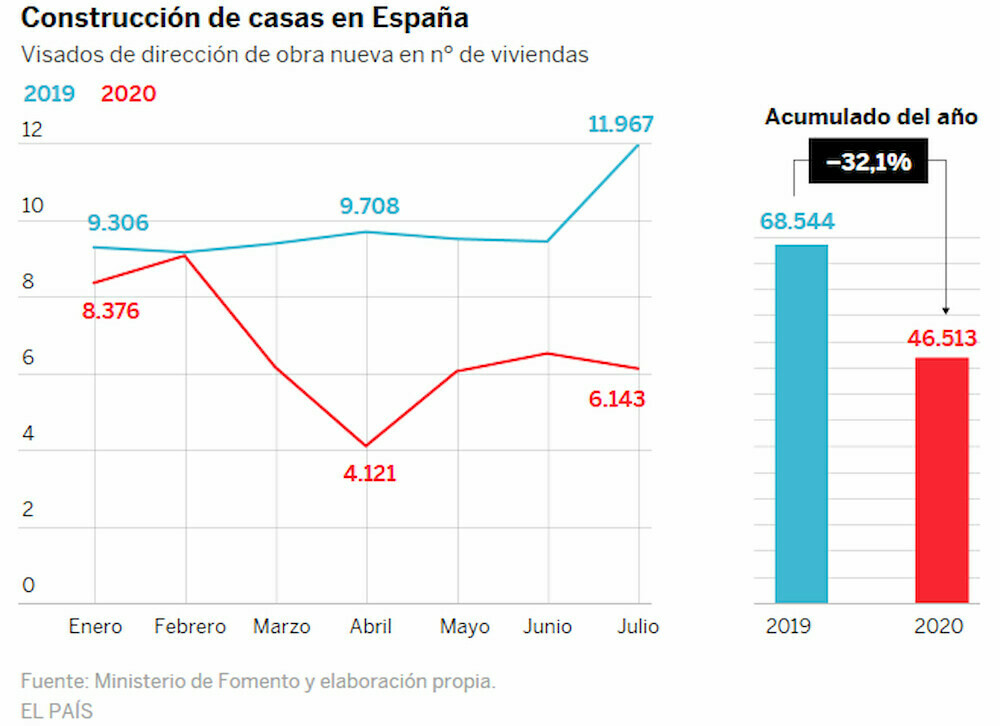
In spring 2020, when it became clear that the coronavirus pandemic was here to stay, a number of Spanish experts predicted a sharp drop in prices in the local real estate market. However, subsequent events had the opposite effect: on June 9, a decree “On combating the consequences of the COVID-19 pandemic in the workplace” came into force in Spain. Now all construction sites must use sanitizers and disinfectants, workers must constantly wear masks and gloves, not to mention social distancing and other rules. As a result, the cost of work increased by almost 7%, and construction speed decreased.
In summer, the topic of an impending new construction shortage became one of the main ones in Spanish media. According to an investigation by El País editors, Spain lost a third of new construction in 2020. Due to Covid-19, some developers abandoned plans or took a pause. Thus, in 2020, about 70,000 residential units were completed in Spain versus 106,000 in 2019.
The shortage of new construction combined with rising construction costs led to prices for Spanish new construction reaching a 10-year high: €2472 per square meter, according to Appraisal Society researchers.
Growth in domestic demand and changing preferences
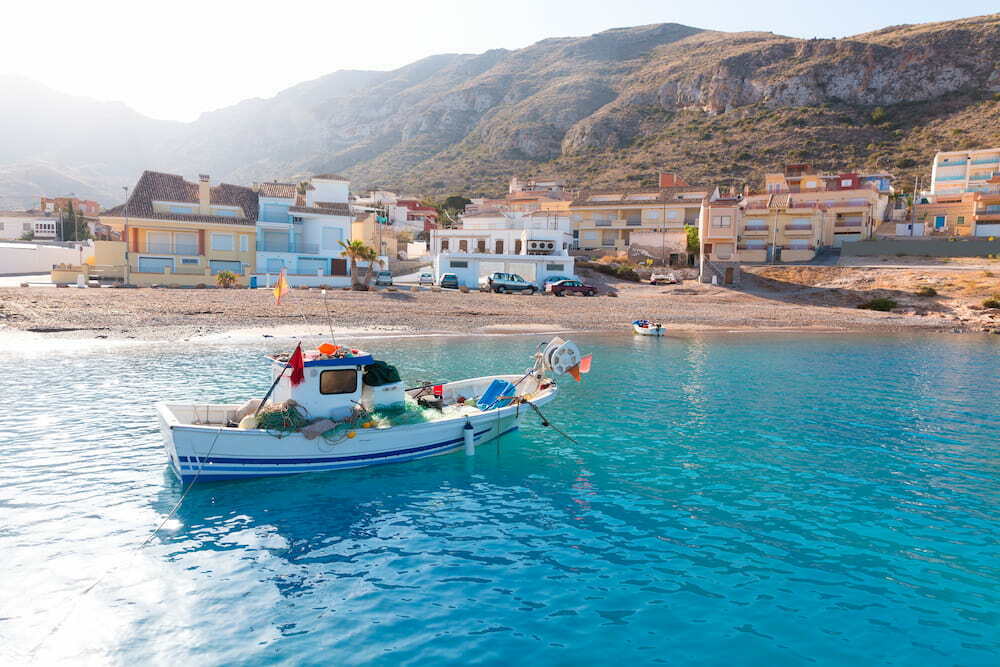

This trend is explained by people’s desire to stay away from major cities and crowds to reduce the likelihood of virus spread. In addition, during quarantine, many Spaniards chose less crowded areas, as well as premises with terraces and more light (in March, when the pandemic began, about 8% of Spaniards lived in rooms with windows facing the interior courtyard, i.e., without a street view).
Thus, in 2020-2021, for a local resident, their own small house is preferable to a large apartment. People studying and working from home consider separate rooms better than one large space. Open areas — terraces — have also increased in price.
According to the Fotocasa portal, since the beginning of the Covid-19 pandemic in Spain, demand for rural houses (+46%), villas (+36%) and two-family townhouses (+24%) has significantly increased. Demand for apartments, on the contrary, fell by 14%. In the third quarter of 2020, 20.4% of all transactions were sales of detached houses — a record in the history of observations.
The highest demand is for real estate in cities with populations up to 5,000 people, as well as on islands and in coastal zones, where the level of coronavirus incidence is lower, according to WHO and Spanish Ministry of Health data. The lowest incidence was recorded in the Canary Islands (80 cases per 100,000 people in individual cities). Doctors attribute this to the beneficial effect of fresh air.
According to Via Celere analysts, changing preferences led to 54% of Spaniards planning to change their place of residence in 2021. In addition, some Spanish parents in 2020 purchased housing for their children so they could study or work remotely. Thus, thanks to growing domestic demand and rising new construction prices, local real estate maintains its position even in difficult times, and the average price does not fall. According to the National Statistics Institute of Spain, more transactions were completed in the third quarter of 2020 than in the second, indicating gradual market recovery.
Remote and quick sales
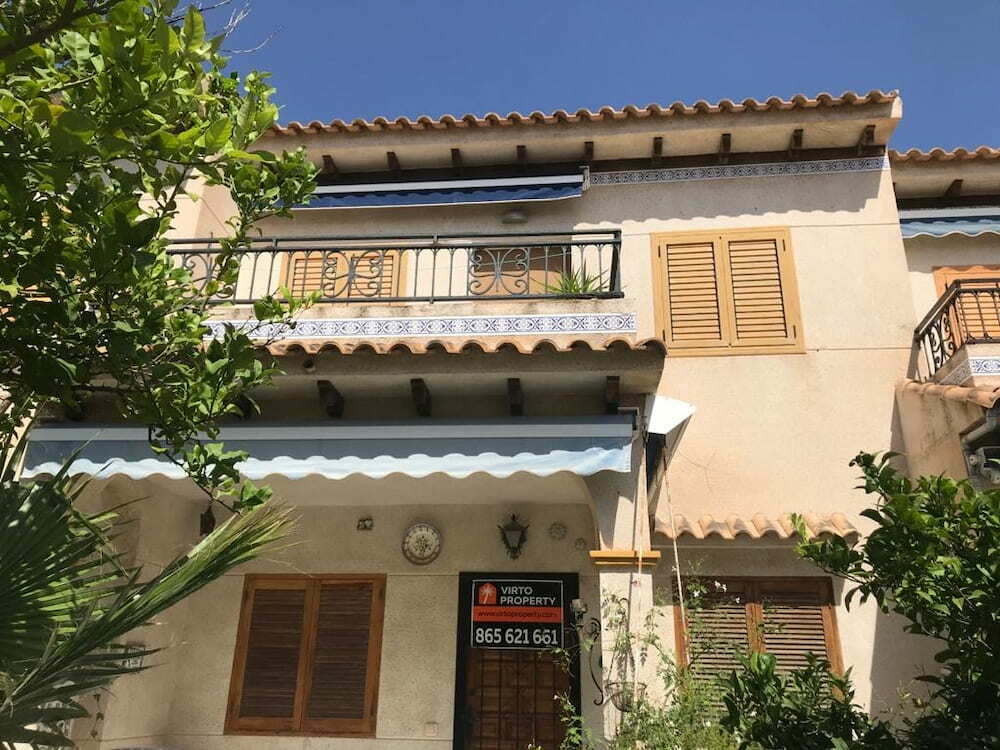
With the onset of the pandemic, advertisements marked “urgent” began appearing on Spanish real estate websites. This is especially characteristic of the secondary housing market, which proved more sensitive to changes. Unfortunately, Spain became one of the leaders in the number of Covid-19 victims, especially among the elderly. As a result, the market was filled with a large amount of inherited real estate.
In 2020, many locals left their homes for safer areas or closer to the sea and nature. Because of this, the share of urgent deals in the housing sector grew. “Remoteness” in 2020 became a trend not only in the workplace, but also in sales. Many companies, including VirtoProperty, now offer remote purchase services: a transaction can be conducted from home, without travel.
Regarding secondary housing prices, there was a 6% decline in the second quarter of 2020; by the end of the year, the indicator decreased slightly. According to BBVA bank analysts, from April to September 2020, the number of transactions in the secondary market decreased by 26.1% across the country, so the market “rolled back” to early 2019 indicators.
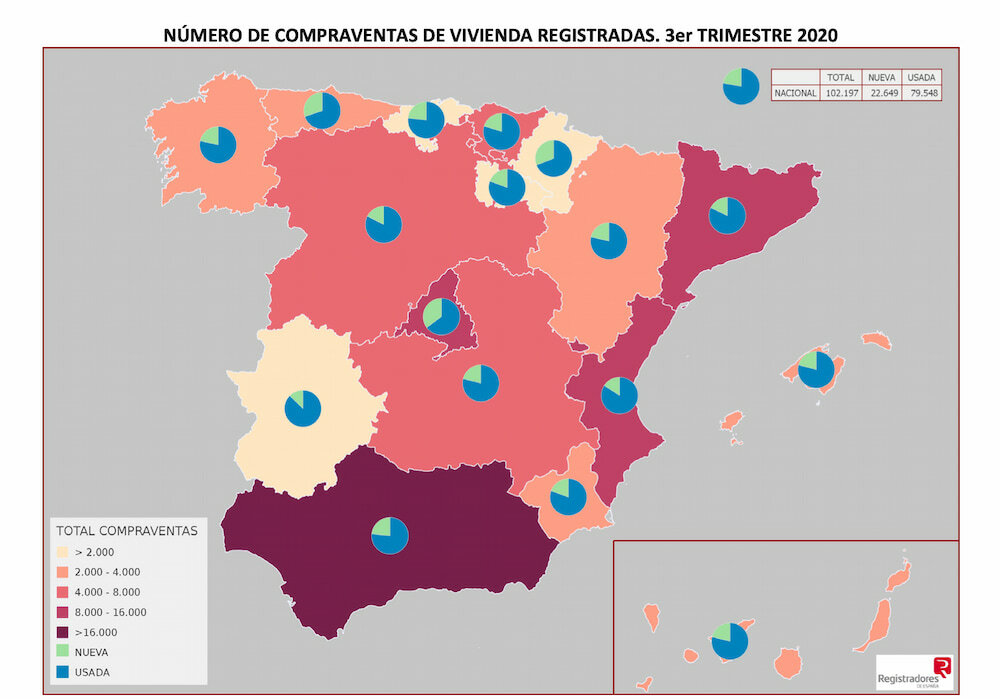
Remote sales appeared by the end of spring, allowing foreigners to return to the Spanish real estate market. Thus, in the third quarter, foreigners accounted for 28.14% of all housing transactions in the Balearic Islands, followed by the Canary Islands and Valencia. According to Spanish Registrars, the most active foreign investors are from Italy, France, Belgium, Germany and Morocco.
Rental boom

In 2020, many home buyers worldwide were forced to cancel deals due to uncertainty during the pandemic. Spain was no exception, so locals and foreigners massively switched to rentals. According to Idealista, since the beginning of the pandemic, the number of rental advertisements across the country has grown by 63% (+80% in the room rental segment), as many postponed purchases until calmer times and chose rentals.
As a result, the average return from renting Spanish real estate increased to 8.2% (of the property value per year). Before the pandemic, the indicator was 7.6%. Offices showed the highest return (10.9%), followed by residential premises (9.3%) and parking (7.6%). By the end of summer, the cost of housing rental in Spain reached a historic high: an average of €11.4/m² per month. Important factors determining rental prices are the presence of a pool and elevator.
Spanish hotels rented rooms to locals as an alternative to offices. The price of a “workplace” ranged from 10 to 120 euros per day (usually from 8:00 to 20:00), and conference rooms could also be rented.
Residence permit as a way to get to Spain

Most borders between countries are still closed, and embassies are not issuing tourist visas. The only way to get to Spain from a non-EU country is to apply for a residence permit, which requires first obtaining a national type D visa. Such a visa allows staying in Spain for its entire validity period.
Since the beginning of the pandemic, maximum demand for Spanish D visa has been recorded. Demand for immigration services will remain a trend throughout 2021.
There are various grounds for obtaining a type D visa. When it comes to real estate, the fastest option with maximum advantages is an investment visa, or Golden Visa. To obtain it, you need to invest at least €500,000 in local real estate or securities, after which you and your relatives can live in Spain, get a job, move freely within the Schengen zone and much more.
Information demand for Golden Visa in 2020 grew by more than 70%. The same trend continues in early 2021, when a national visa remains one of the most accessible ways to get to Spain. However, it’s not necessary to spend half a million euros. You can obtain a residence permit in Spain through long-term rental and proof of income.
There are 9 legal ways to obtain a residence permit in Spain: through real estate, work, study, family ties, refugee status and other grounds.
4. Current property prices in Spain
Provinces with highest demand among foreigners
Let’s look at the Spanish provinces most popular among foreigners — mainly coastal resort zones and islands. Below is a list of all Spanish provinces with a share of foreign purchases over 10%. Alicante took first place, followed by Santa Cruz de Tenerife and Málaga.
Province (autonomous community); price per m² at the beginning of 2021; price change to 2020; share of foreign purchases (3rd quarter 2020)
Alicante (Valencia); €1612; +3.1%; 38.14% Santa Cruz de Tenerife (Canary Islands); €1795; +1%; 32.56% Málaga (Andalusia); €2269; +3%; 30.25% Girona (Catalonia); €2039; -0.7%; 27.71% Balearic Islands (Balearic Islands); €3105; +1.5%; 27.14% Las Palmas (Canary Islands); €1925; +2.4%; 19.77% Murcia (Murcia); €1046; +0.2%; 17.49% Almería (Andalusia); €1075; -0.3%; 13.63% Castellón (Valencia); €1073; -1%; 13% Tarragona (Catalonia); €1339; -1.3%; 12.26%
Property prices in capital cities
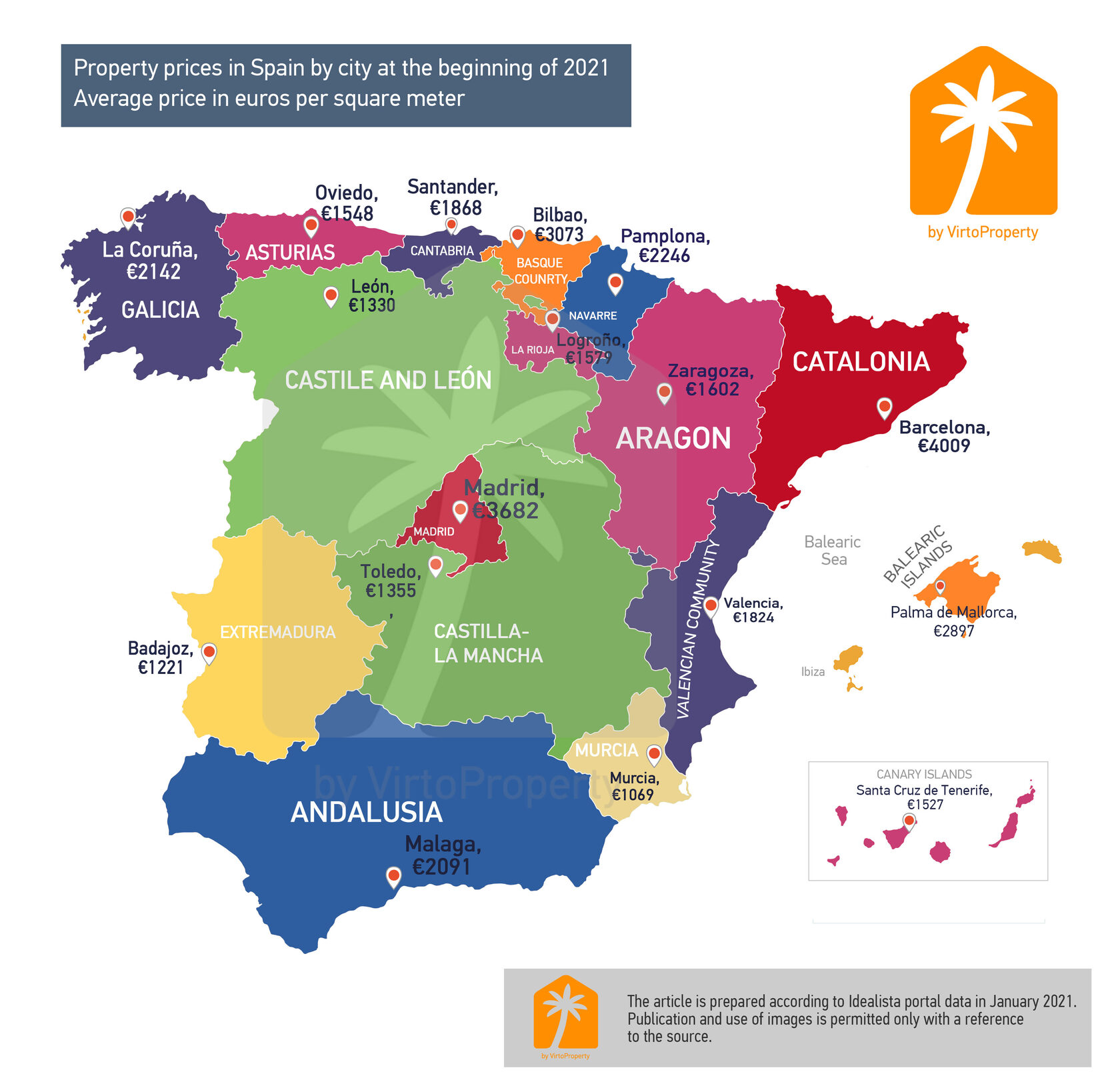
Let’s look at the infographic with prices in the capitals of autonomous communities at the current moment. Reminder: in 2020, there was a trend of locals moving to small towns, so large cities could not grow in price or became cheaper. This is especially characteristic of central Spain (Madrid, Toledo, Zaragoza and others).
Price examples on the coast in early 2021
As already mentioned, the overwhelming majority of foreign home buyers in Spain, including Britons, are interested in buying property on the Mediterranean coast. Below are price examples for various types of properties in locations popular among foreigners.
Location; property type; price in EUR
Torrevieja, Costa Blanca; apartment (resale), 2 bedrooms, 58 m², 180 m to sea; 59,900
Orihuela Costa, Costa Blanca; bungalow (new construction), 3 bedrooms, 86 m², pool, 2 km to sea; 190,000
Villamartín, Costa Blanca; villa (new construction), 3 bedrooms, 193 m², pool, 3 km to sea; 290,000
Alicante, Costa Blanca; apartment (resale), 1 bedroom, 54 m², 900 m to sea; 68,000
Alicante, Costa Blanca; apartment (resale), 4 bedrooms, 120 m², 840 m to sea; 103,000
Benidorm, Costa Blanca; apartment (new construction, delivery in 2022), 3 bedrooms, 129 m², 390 m to sea; 289,000
Finestrat, Costa Blanca; apartment with pool (new construction), 2 bedrooms, 74 m², 6 km to sea; 205,000
Dénia, Costa Blanca; apartment with garden (resale), 2 bedrooms, 65 m², 460 m to sea; 180,000
Estepona, Costa del Sol; apartment (new construction), 3 bedrooms, 139 m², 1 km to sea; 345,000
Málaga, Costa del Sol; apartment (new construction), 1 bedroom, 37 m², 1 km to sea; 127,000
Marbella, Costa del Sol; villa (new construction), 3 bedrooms, 253 m², 850 m to sea; 1,345,000
5. Spanish property price forecast for 2021
In 2021, due to the economic consequences of the Covid-19 pandemic, property prices will fall in almost all housing markets of Western European countries, report S&P Global Ratings analysts. Regarding Spain, the agency forecasts a housing price decline of 3-3.5% with expectations of resumed growth in the second half of 2022.
According to credit rating agency Fitch, housing prices in Spain will fall by 4-6% over the next year, after which they will stabilize in 2022. The agency studied the situation in real estate markets of sixteen largest world economies and concluded that Spain will show the greatest price decline along with the UK due to unemployment caused by the pandemic.
Coronavirus, even if it ends in the coming months, will long affect the value of Spanish real estate, note experts from Spain’s largest bank CaixaBank. According to their research and forecasts, in 2021 local property prices will fall by 6-9%, and return to pre-crisis indicators is possible no earlier than 2024. Specialists claim that recovery to pre-crisis values will not occur before 2023. At the same time, the study notes that the current crisis will lead to smaller losses in the real estate sector compared to 2008.
S&P Global Ratings gave a positive forecast: the market will recover in the second half of 2022. As of early 2021, experts are already making optimistic forecasts: if spring begins with mass vaccination and the disease can be brought under control, the market has every chance to recover by the end of 2021.