Prices risen since crisis
Contents

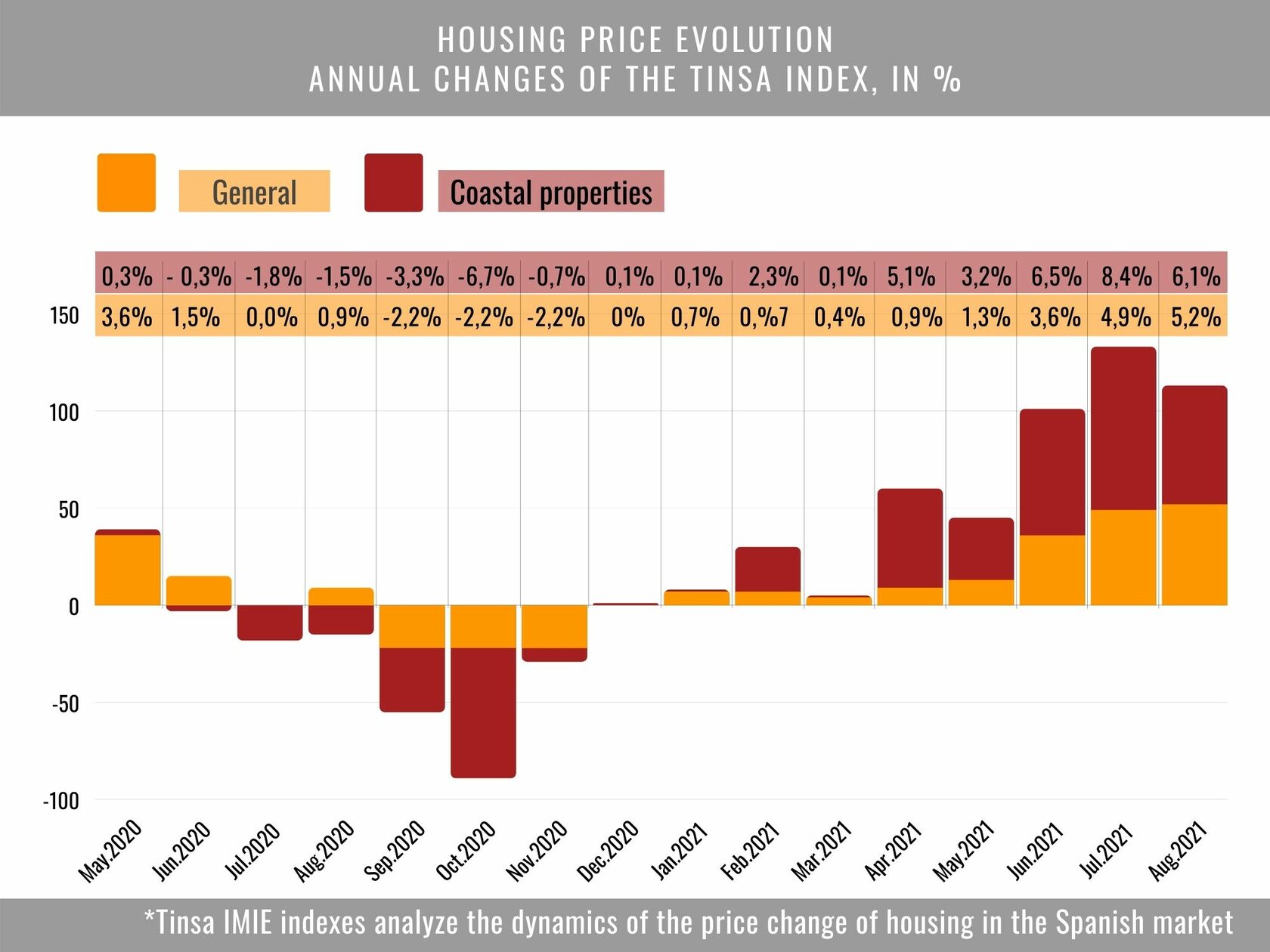
Tinsa’s General Housing Price Index shows that apartment values have increased by 5.2% over the last month compared to the price decline that began last summer due to the pandemic. In August, with a 0.4% increase, new and second-hand housing maintained the trend of moderate price growth.
IMIE General and Large Markets statistics from Tinsa, published today, records an annual housing price growth of 5.2% in August and a monthly growth of 0.4%. The largest differences compared to last year were recorded on the islands (7.9%) and in inland and small municipalities (7.1%). Compared to the previous quarter, housing became more expensive by 3.3%, with the highest growth observed in small municipalities of inland regions (4.5%) and in capitals and large cities (4.3%).
“The comparison with the period of greatest decline, concentrated in the second half of last year, demonstrates high annual rates of change that are part of an upward trend,” noted Andrea de la Hoz, senior analyst of Tinsa’s research department.
Taking into account the corrections that occurred in 2020 and the subsequent gradual recovery, the average property price in Spain is 3.3% higher than in March 2020, when the pandemic began. The groups showing the greatest upward dynamics after almost a year and a half are small municipalities of inland regions and the Atlantic coast with a 4.5% increase compared to March 2020, as well as capitals and large cities, where the difference reaches 4.3%.
Recovery faster than stimulus

“The overall recovery is proceeding at a faster pace than expected, amid continuing economic stimulus in Europe and low interest rates. The housing market is in a scenario of sustainable price growth, increasing demand and limited supply,” continues Andrea de la Hoz.
Compared to last year: islands and inland municipalities
On an annual basis, the highest growth in August was recorded on the islands (+7.9%) and in the “Other municipalities” group (+7.1%). The Mediterranean coast also exceeded the national average of 5.2% with an annual growth of 6.1%. The most moderate rates of change compared to August 2020 are observed in suburban areas (+4.9%) and capitals and large cities (+3.8%).
“In the short-term monthly dynamics, the islands are the group showing the most pronounced price growth (+4.2% per month). The rest showed fluctuations or slight declines. Thus, a 1.1% monthly growth in the “Other municipalities” group or +0.5% in capitals and large provinces, which, according to the expert, “slow down growth compared to previous months”. In suburban areas, the average price decreased by 1.6% between July and August and by 0.6% on the Mediterranean coast, which remains practically stable compared to the previous month.”
Islands and capitals - best performance since reaching lows
Housing in Spain has on average become 21.7% more expensive since the minimum recorded after the 2008 financial crisis, while remaining 30.2% below the 2007 peaks, according to the report. The growth was more pronounced on the islands, where the average price increased by 38.4%, followed by capitals and large cities (+31.2%). At the opposite pole, the “Other municipalities” group barely grew in value by 10.8% since the lows.
The largest gap compared to the 2007 maximums was recorded on the Mediterranean coast and in suburban areas with accumulated declines of 40% and 37.4% respectively. On the other hand, the Balearic and Canary Islands stand out with the smallest accumulated fall from peak values: 9.4%.
Source: Expansion.com (September 3, 2021)