Spanish Property Buying Process
Contents
Step 1: Find an independent lawyer
Step 2: Obtain NIE
Step 3: Open a bank account
Step 4: Mortgage application
Step 5: Reservation agreement
Step 6: Preliminary property inspection and legal due diligence
Step 7: Obtaining the mortgage
Step 8: Preliminary purchase agreement (arras)
Step 9: Purchase agreement (Escritura de Compraventa)
Step 10: Tax payment
Step 11: Property registration
Conclusion
1. Find an independent lawyer

Before signing contracts, it is strongly recommended to find an independent lawyer specializing in Spanish land law (urbanismo). Ideally, the lawyer should speak both Spanish and your native language — this will save on translation costs.
A qualified lawyer will help order and verify the necessary documents. Since employees of Spanish government institutions often do not speak English, and foreign buyers may not be aware of legal pitfalls, professional assistance is invaluable.
Key provisions:
Citizens of any country can purchase real estate in Spain
Residence permit or local authority permission is not required
Foreign buyers can purchase apartments, villas, land plots and commercial real estate
The share of foreigners comprises about 15% of all transactions
The most active buyers are from the United Kingdom, France and Germany
Spain provides a “Golden Visa” for purchases over €500,000
2. Obtain NIE
A foreigner needs an identification number (Número de Identificación de Extranjero) to conduct legal operations — purchasing real estate, employment or conducting business. It can be obtained at the Spanish consulate in your country or at any police immigration office in Spain.
Required documents:
Original passport and copies of all pages
Two photographs
Payment receipt (about €10)
Completed application form
Processing usually takes from several days to several weeks depending on the volume of applications. Real estate agents often help clients obtain NIE.
3. Open a bank account
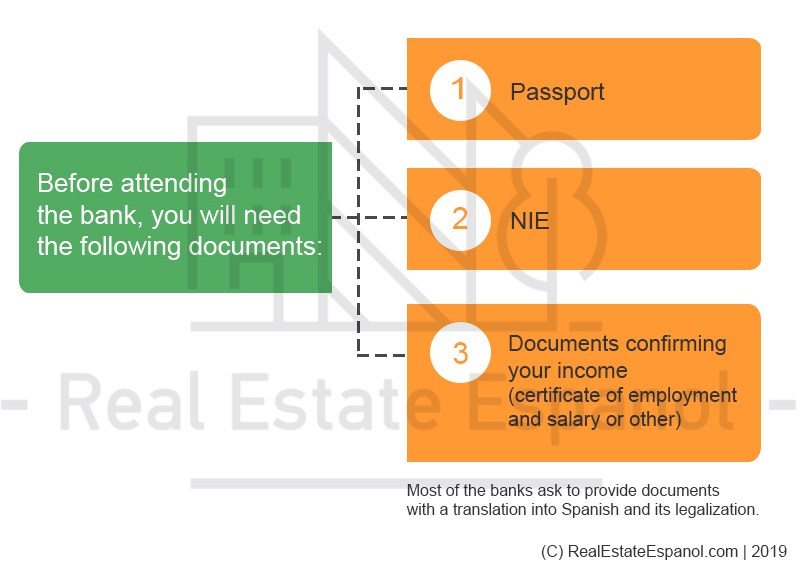
A bank account with a Spanish bank is necessary for purchasing real estate. Many institutions work with foreigners, including Sabadell, BBVA, Bankia and Caixabank.
Required documents:
Valid identification
Proof of residential address
Initial deposit
Euro account operations are initially free, but quarterly or annual commissions are then applied with a positive balance. Utility bills are paid from this same account. Banks provide online access for remote operations.
If you plan to apply for a mortgage, it is advisable to open an account at the bank where you will receive the loan.
4. Mortgage application
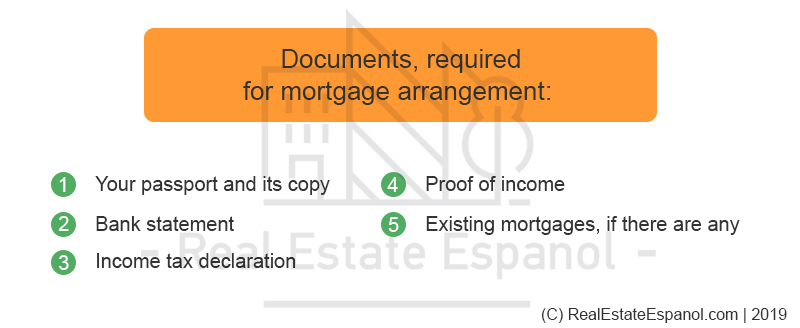
Mortgage loans in Spain are relatively accessible to foreign citizens, although requirements have tightened due to the increase in loan defaults and property abandonment for economic reasons.
Application review now takes 4–6 weeks instead of the previous 2–3 weeks. There are no uniform document requirements among Spanish banks — they vary depending on the institution, including regarding translations into Spanish.
Required documents:
Employment certificates
Tax returns
Bank statements
Documents for owned real estate or securities
Spanish banks typically offer financing up to 80% of the property value for a term of 10–30 years at approximately 3.2% annually. European regulations require that mortgage payments do not exceed 30% of income (i.e., the borrower must earn three times more than the monthly payment).
After receiving preliminary approval, the buyer can sign a reservation agreement and make a deposit.
5. Reservation agreement

When a property is found, reservation is not mandatory but widely practiced. This agreement is concluded between the buyer and the owner, real estate agency or developer.
The agreement specifies the property price and the deadline for concluding the sale deed, usually 15–30 days.
The buyer makes a deposit of 1–1.5% of the property value, typically €3,000–€6,000 for standard real estate. Funds are kept in an escrow account or with a reliable intermediary.
Important warning when buying under construction: Never make deposits before receiving a copy of the approved building permit (Building License). If there is no permit and money has been paid, bank guarantees on deposits lose their force.
The agreement fixes the parties’ intentions and establishes liability in case the deal falls through. Conditions for legal verification must be included; if problems are discovered, money can be returned.
After reservation, the agent or lawyer orders a Nota Simple — a document containing information about all owners and encumbrances (such as mortgage or municipal reconstruction obligations).
This agreement protects against troubles that could lead to money loss when signing a preliminary contract if legal verification reveals problems. If the deal goes through, the deposited amount is credited toward the property cost.
6. Preliminary property inspection and legal due diligence
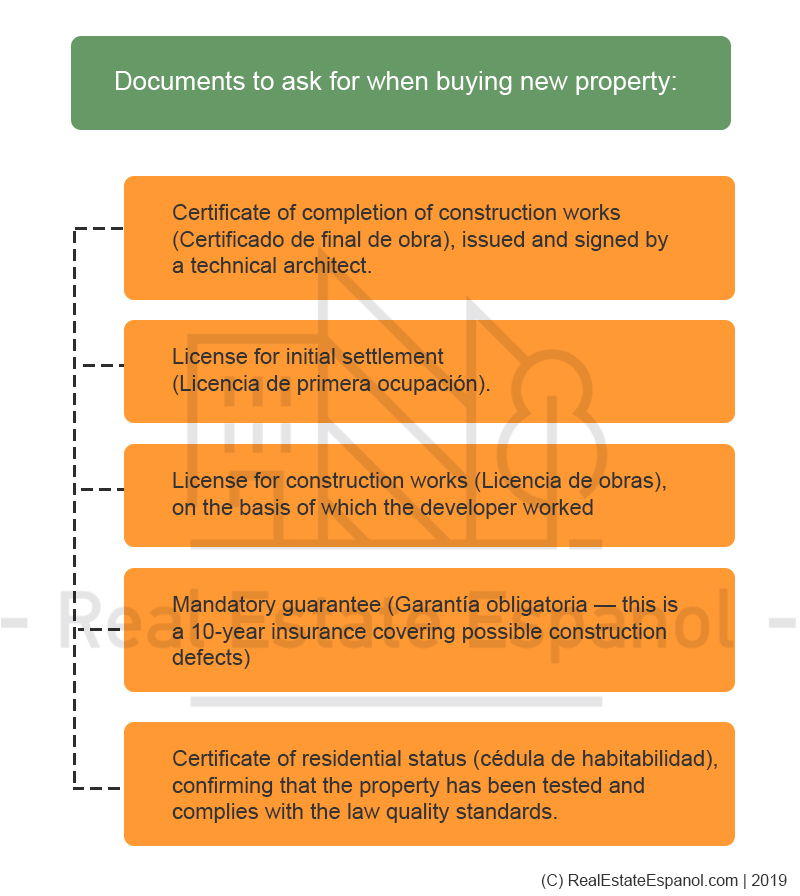
Everything must be verified by your lawyer BEFORE signing any contracts. The buyer ensures that the property matches the seller’s description.
Documents to request when buying secondary real estate:
Nota simple (extract from the Property Registry, Registro de Propiedad http://www.registradores.org/ ), which can be requested online. This document indicates the owner and existing encumbrances (e.g., mortgage loan) and embargoes (property seizure by court decision), if any.
Check information in the Real Estate Cadastre (Catastro), data in the Property Registry must match the Cadastre data. If something is wrong, contact your notary.
Check inventory data. Request a certificate (Certificación catastral descriptiva y gráfica), which includes a description of the property (ownership, built area, location, etc.) and its plan. This certificate can be requested by any interested party.
Ensure there are no tax debts (Impuesto de bienes inmuebles). For this, you need to contact the municipal tax service.
Check regular payment of utility bills (Gastos de comunidad). The certificate is issued either by the board secretary or by an employee of the management company (Administración de fincas).
Review the residential complex charter (Estatutos de la comunidad). This document regulates the condominium’s operation, general behavioral norms, rules for conducting private construction work.
Energy certificate, which is issued by accredited technical services. At the time of signing the deed, the notary checks the certificate and attaches a copy.
7. Obtaining the mortgage

After submitting the necessary documents, the bank calls an appraiser (tasador) to prepare an appraisal report (tasación).
Banks can issue a mortgage of up to 80% of the property value based on this appraisal.
Application review takes approximately one month.
Borrower expenses include:
Bank commission: 1–2%
Stamp duty: 0.1–2% of the loan amount
Property appraisal by appraiser: €250–€500
Property insurance: €250–€350 per year for medium-value properties
With a positive decision, a notarial mortgage agreement and deed of sale are signed, which are registered in government registries.
8. Preliminary purchase agreement (arras)
After inspecting the property and making the final decision, the parties sign a preliminary contract (Contrato de arras). This document contains information about the property, seller obligations (repairs, furniture provision) and buyer obligations (deadlines for signing the deed and final payment amount).
Unlike the reservation agreement, the arras contract is a private legal document that is not yet entered in the Registry but remains legally binding and does not require notarial certification.
Upon signing, the buyer transfers 10% or more of the property value to the seller depending on agreements. Penalties are usually provided for cancellation. For example, a withdrawing buyer loses the deposit, while a withdrawing seller must return the deposit in double amount.
Possible reasons for transaction delay:
Delay in bank decision on mortgage issuance
For some valid reasons when the buyer cannot make payment
If the buyer discovered problems with property condition requiring repair, or to demand return of funds
If the notary is not satisfied with the provided document package
Construction deadline delays when buying under-construction housing
For under-construction housing, payments are made to an escrow account, preventing fund withdrawal until actual transaction completion.
9. Purchase agreement (Escritura de Compraventa)

When all documents are ready, the transaction is completed. The buyer transfers the remaining amount to the seller’s account and signs the purchase agreement (deed of sale, or Escritura de Compraventa) before a notary in accordance with Spanish law.
The buyer signs the document with the owner or developer. When purchasing with a mortgage, a bank representative is present.
The notary’s presence is a formality; the notary is not obligated to explain contract clauses. Independent legal consultation with correct translation is recommended.
For those who do not speak Spanish, a sworn translator is recommended.
If the contract raises no objections, the notary sends a reservation request to the Property Registry, preventing other operations with the property.
Payment method: Real estate purchases are typically paid by checks. Foreigners open a bank account in Spain, transfer funds from their country (with confirmation of income source) and receive bank checks, which are transferred to the seller.
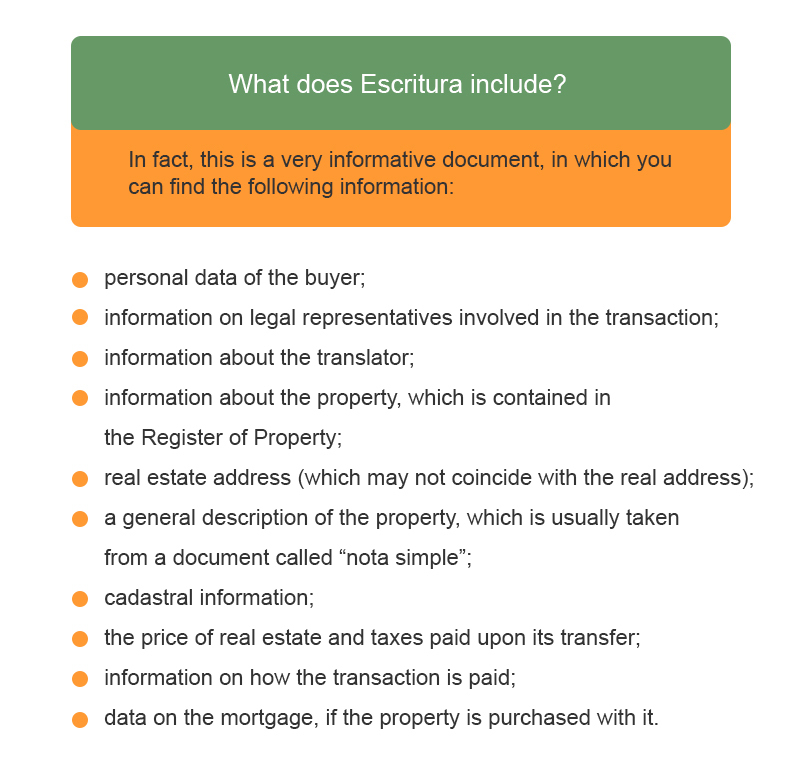
Upon signing, the buyer receives:
Keys
Property documents
Tax and utility payment receipts
Copies of the deed (originals are retrieved after registration in the Property Registry, in 1–3 months)
The owner receives keys and property maintenance documents (for primary market — service contracts from the developer; for secondary — existing contracts that need to be renewed).
Under Spanish law, the deed is signed by the seller, buyer, accompanying lawyer, translator and notary. Documents are kept in the office of the notary who conducted the transaction. Escrituras are composed exclusively in Spanish, regardless of the buyer’s nationality.
Power of attorney: Real estate purchase and deed signing can be carried out by power of attorney if multiple trips to Spain are undesirable. Options:
Drawn up by a notary in Spain;
Drawn up by the Spanish consulate in another country.
Drawn up by a notary in another country. Before this document can be used in Spain, it must be legalized with an apostille in accordance with the Hague Convention.
10. Tax payment

For buyers:
Within 30 days of transaction completion, taxes must be paid and documents submitted for property ownership registration.
Taxes include:
Primary market: VAT and stamp duty (10% + 0.5–1.5%) or secondary market: property transfer tax (6–10%). VAT on land plots and commercial real estate is 21%.
Registration expenses: 0.02–0.175%
Example calculation of purchase expenses (property worth €340,000):
| Item | Cost |
|---|---|
| Notary | €800 |
| Taxes | €8,500 |
| Registration | €415 |
| Administrative assistant | €420 |
| Total | €10,135 |
Example calculation of mortgage loan expenses (€260,000):
| Item | Cost |
|---|---|
| Notary | €900 |
| Taxes | €5,200 |
| Registration | €440 |
| Administrative assistant | €440 |
| Total | €6,980 |
Additional expenses:
Agency services: Usually agent commission in Spain is 3-5% of the property price. This amount is usually paid by the seller, while for the buyer this service is free. But there may be exceptions, especially if the buyer requires additional services. For example, the agency may charge the buyer 3% of the property price, and this amount already includes not only property search and contract signing support, but also lawyer fees, help obtaining NIE, opening a bank account, mortgage loan assistance and other services. We recommend discussing this issue with your agent before signing any contract.
Lawyer fees: The amount depends on the specialist and transaction complexity. Some lawyers charge hourly rates (50–300 euros per hour), others have fixed rates for verification and conducting standard real estate transactions (1,500–2,000 euros), while others take a percentage of the property price (1–1.5%).
Notarial fees and property registration: The buyer pays for notary services and property registration in the Property Registry. This amount is calculated by the notary, typically it comprises 1-2% of the property price.
Translator services: If the buyer does not speak Spanish, a translator must be present during signing. The basic rate for this service is 100 euros per hour + VAT. Careful reading of the contract may take several hours. Translator assistance may be included in the agency fee.
Mortgage expenses: You will need to pay for property appraisal (300–500 euros), loan opening commission (0.5–1%), property insurance (200–1,000 euros annually, depending on coverage amount and property type).
For sellers:
Sellers pay tax on the difference in cadastral value (increase in cadastral value). Tax residents or Spanish citizens declare the difference between purchase and sale price as income, paying 24% income tax. Sellers typically pay the commission of the agency that facilitated the transaction.
11. Property registration

Property registration is carried out in the Property Registry (http://www.registradores.org/). For this, an application must be filed with original contracts and tax payment documents; usually the filing is done by the notary.
In 2–3 months, the buyer receives contracts with Registry extracts confirming ownership rights.
The buyer is obligated to notify the Cadastre (Catastro) (http://www.catastro.minhap.gob.es/) of any significant property changes, such as erecting or demolishing walls. Penalties are provided for non-notification.
Since 2014, this law became mandatory. Make sure previous owners notified the Cadastre of all changes — otherwise penalties may transfer to the new owner.
12. Conclusion
Spanish laws do not restrict foreigners in purchasing real estate. All types of properties are available.
Any owners of Spanish real estate have the right to multiple-entry Schengen visas; when purchasing for an amount from €500,000, residence permits can be obtained.
A notary is a mandatory participant in the transaction. A purchase cannot be registered without their participation.
Spain has no fixed tariffs for agent service payments; discuss this issue with specialists.
Local residents and foreigners pay the same taxes.
Additional purchase expenses comprise 10–15% and are added to the property cost.
Tips:
Always know what you are going to sign
Spain has its own laws, so you need to carefully consider each step of the purchase and not try to save on lawyers
Engage independent experts for legal consultations
To find the property of your dreams, you have already found excellent specialists — our agents!