Home Purchases Rise Amid Price Growth: 5 Indicators That May Signal a Real Estate Bubble
Home Purchases Rise Amid Price Growth: 5 Indicators That May Signal a Real Estate Bubble

Spain’s real estate market is on the rise. Sales volume—over 50,000 transactions per month—is growing, and prices continue to increase. Is a new bubble approaching?
Currently, there is consensus among experts: the market as such is not in a bubble. However, the Bank of Spain in its latest Financial Stability Report warns of the need to “closely monitor” the evolution of several indicators, “to understand whether they stabilize at current values or, conversely, begin to rise to alarming levels.” The regulator tracks four aspects: supply dynamics, demand, prices, and mortgage lending. At the international level, the continued placement of capital predominantly in residential real estate, rather than in more productive sectors, is causing concern.
Supply and Demand
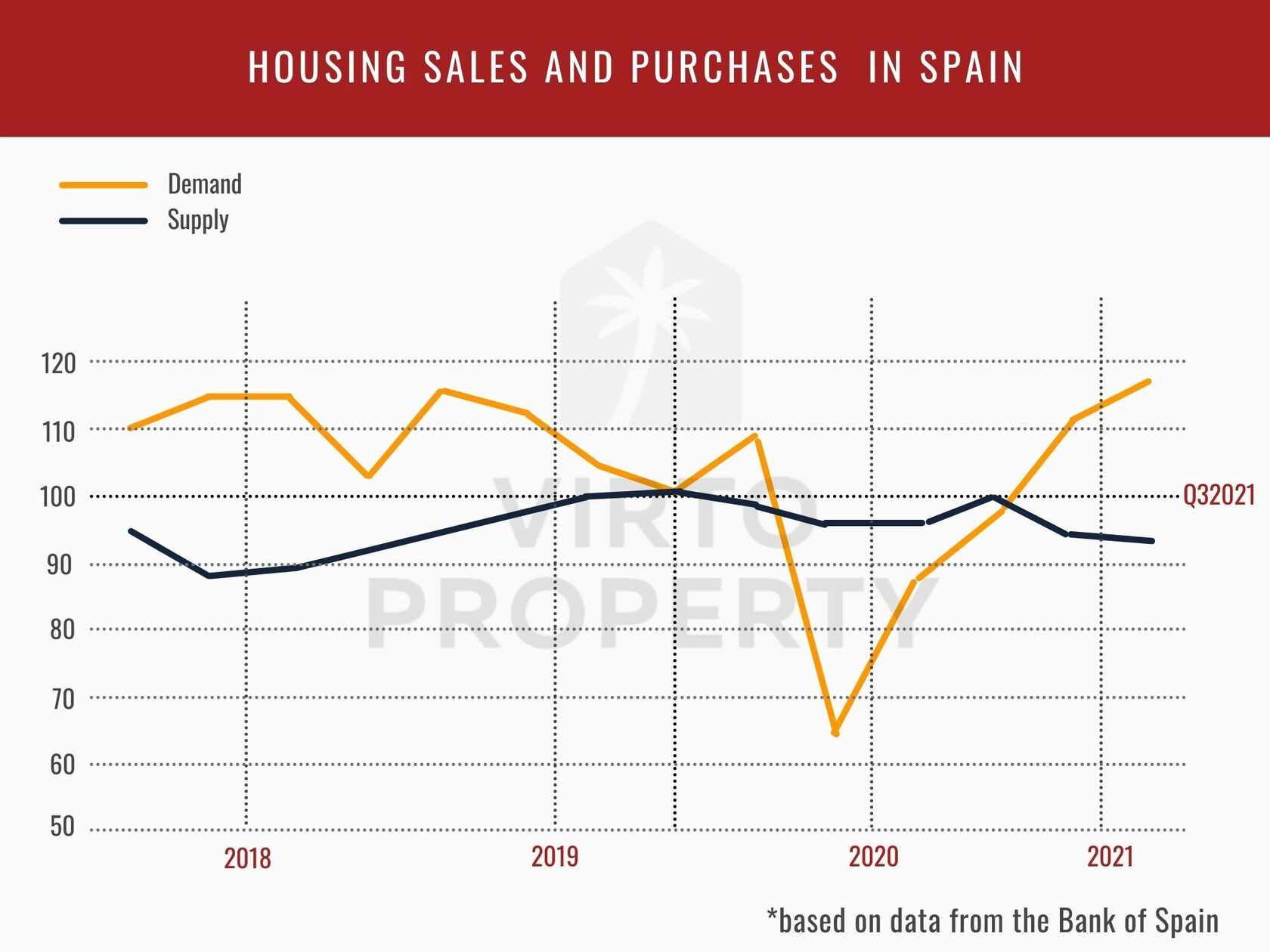
Home sales and purchases demonstrated a strong rebound in the first nine months of 2021—nearly 8.5% compared to the same period in 2019 (before the pandemic), against more restrained supply dynamics.
This interest in buying is supported, in addition to the improvement in the general economic situation and comfortable financial conditions, by the realization of investment decisions postponed until the beginning of the pandemic.
At the same time, the Bank of Spain emphasizes: “Housing supply shows weak dynamics, and if current trends continue, it may not be sufficient to cover growing demand in the coming years.”
In other words, in the short term, tension may arise between housing supply and rapidly growing demand, which will affect prices (the next indicator requiring close attention).
In September, 53,410 transactions were concluded—the highest figure in 14 years, according to the National Institute of Statistics. Francisco Iñareta, spokesperson for Idealista, states: “The statistics emphasize the favorable moment that the real estate sector is experiencing, and how buyers’ appetite grew by the end of summer, supported by low interest rates and record household savings.” But he adds: “The data may indicate that recovery from the pandemic is nearing completion and we will soon see stabilization of indicators.”
Prices
The Bank of Spain explains in its report: “This growth in purchases led to an acceleration in average housing prices in the second quarter, thereby interrupting the slowdown trend observed since the beginning of 2019.”
The intensification of housing price dynamics, recording 3.3% growth year-on-year, was observed both in the new construction segment (6%) and, to a lesser extent, in the secondary market (2.9%).
New housing prices demonstrated higher growth in recent years, which may be related to this type of housing’s greater ability to adapt to buyer preferences and the greater supply deficit in this segment compared to the secondary market. The Bank of Spain warns: “The recent notable increase in construction materials prices may create additional pressure on new housing prices.”
Nevertheless, María Matos, Research Director at Fotocasa, notes after record sales and purchases in September: “The most important thing is that prices are not growing at the same pace as the number of transactions, and remain restrained.”
In any case, the Bank of Spain closely monitors the sector’s evolution and has calculated that prices have already slightly exceeded equilibrium levels. The Bank expects Spanish housing prices to grow by 5.4% in the 2021-2023 period, although it warns that under an unfavorable scenario, prices could fall by up to 17%.
Nevertheless, the market is still far from a bubble like the one observed in 2007, since prices are 29% below peak levels from that time, according to Tinsa data.
Mortgages
In line with increased sales and purchase activity, the volume of new mortgage loans sharply increased by September 2021. Mortgage lending for home purchases was nearly 26% higher than in the same period of 2019 (a year without pandemic). Despite this, the total volume of debt for this type of lending increased quite moderately, since loan payments also grew, which likely reflects the use of savings accumulated by households at the beginning of the pandemic to accelerate mortgage debt repayment.
The regulator explains: “This rise in mortgage operations appears to be driven predominantly by demand factors, since no signs of loosening credit standards have been observed in recent months.” However, it should be noted that in Spain, most home purchases are paid in cash: in September, only 47.7% of transactions were financed through mortgage loans, according to notaries.
According to Santiago Carbó, Professor of Economics at the University of Granada and Director of Financial Research at Funcas: “There is no indicator pointing to the possibility of a bubble, nor is there disproportionate growth in housing credit (which grows at 0.7% annually).”
The Bank of Spain concludes: “Housing shows no signs of overvaluation, and although the volume of new mortgage lending is actively growing in 2021, it starts from very low levels; this does not lead to a substantial increase in overall debt, and there is no loosening of lending conditions.” “However, if the growth trend in the real estate market continues and intensifies, a reassessment of this risk diagnosis will be required,” the report notes.
International Concerns
Concerns about a possible housing market bubble extend to several countries where alarm signals are sounding due to inflated real estate prices. According to a recent McKinsey Global Institute study, in Australia, Canada, China, France, Germany, Japan, Mexico, Sweden, the United Kingdom, and the United States (these ten markets account for 60% of global value), real estate prices have tripled on average.
The study emphasizes: one of the main reasons is that investors prefer to invest in real estate rather than in businesses more suited to the digital age. The report notes that two-thirds of net wealth in these ten countries is held in residential, commercial, and government real estate, as well as land plots. This, along with rental rate inflation, creates a serious housing access problem for young people.
The analysis warns: the fact that the main part of wealth is invested in real estate, rather than in infrastructure, industrial equipment, machinery, and intangible assets—which are the real drivers of productivity and innovation—leads to a growing gap between wealth and economic growth.