Current Property Price Growth in Spain
Current Property Price Growth in Spain

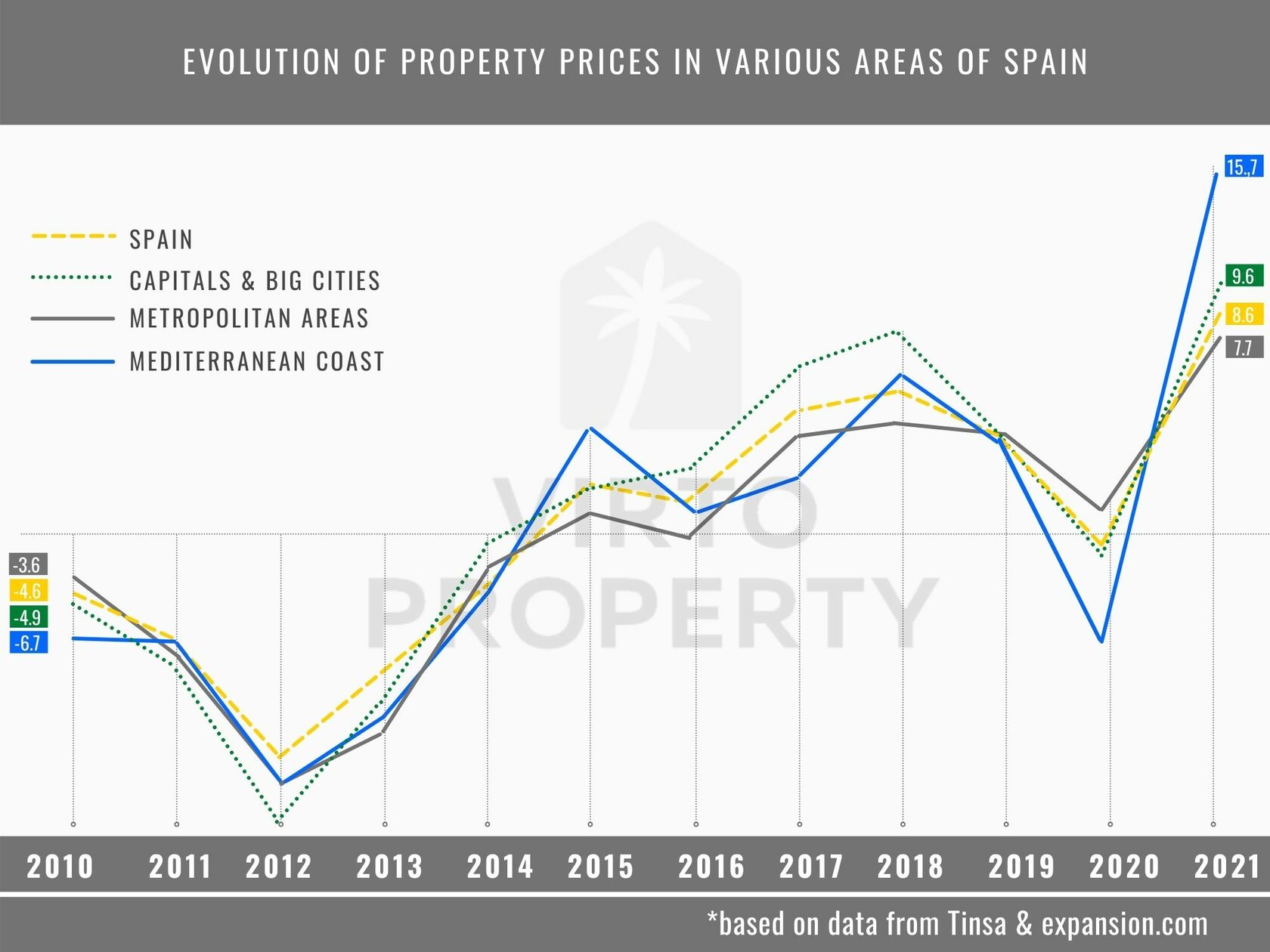
Buying housing in major cities and provincial capitals now costs 5.1% more than in March 2020, before the start of the COVID-19 pandemic, and 9.6% more than in October last year, due to rising demand.
The housing market is returning to its usual situation. The little that could have been shaken by the COVID blow in 2020 is already forgotten. Apartment sales are reviving again, spurred by demand that poured in after the lockdown, record savings, and a huge desire to change housing. In October, buying an apartment is already 5.1% more expensive than in March 2020, directly before the start of the pandemic, according to Tinsa data. This means that housing prices have not only recovered to pre-crisis levels but have exceeded them.
“The real estate sector maintains the recovery momentum that began in the first months of 2021, under the influence of both internal factors (high demand and limited supply) and external ones (rising inflation with low interest rates and cost pressure), which indicates a tightening market,” explains Cristina Arias, director of Tinsa’s research department.
Sales and purchases revived after slowing down and gained momentum at the beginning of the year. If only 39,000 transactions per month were registered in the first months of the year, by August their number approached 50,000 — a figure unseen for the same month since 2007.
Capitals and major cities are pulling the market along — it is here that internal factors manifest most strongly: high demand and limited supply. In these cities, apartment prices are 6.4% above March 2020 levels and 9.6% above October 2020.
The growth in demand is such that it already “exceeds the activity level of 2019,” says Andrea de la Oz, senior analyst at Tinsa’s research department. Against the backdrop of returning buyers, supply remains scarce. “This scenario, combined with a monetary policy of low interest rates, liquidity and available savings, as well as rising consumer confidence and unemployment containment, supports the pace of activity and opens the possibility for price pressure,” adds de la Oz.
“The changes of 2021 reflect the dynamism of the sector, driven by sustained demand, although in a rather moderate key compared to annual indicators, reinforced by comparing current growth with the fall of 2020,” Arias clarifies the difference between the current comparison with October 2020 prices and March last year prices. This is especially noticeable in Mediterranean coastal markets.
In these cities, recovery relative to October 2020 proved particularly impressive — 15.7%, and even exceeds growth in provincial capitals (9.6%). In October 2020, mobility restrictions stopped tourism, which hit a significant part of coastal housing demand formed by foreign buyers. This, coupled with the last lockdown (registry backlogs and accumulation of unsold apartments), led to price drops.
Housing price growth in the Mediterranean compared to pre-pandemic levels is also impressive — 6.1%. This increase may be related, on one hand, to the gradual recovery of mobility, which returned many tourists and potential buyers to Spanish resort destinations, and on the other — to the growth of domestic demand, especially for second homes by the sea. However, the post-vacation slowdown proved quite noticeable: in October, prices fell 0.8% compared to September, a similar trend was noted on the islands (-1.7%).
Islands Have 12% Left to Exceed 2007 Levels
Housing prices in the Balearic and Canary Islands are only 0.1% above pre-pandemic levels. These are destinations that have recovered least compared to pre-crisis indicators — far from the growth above 5% in major cities or Mediterranean resorts.
But the reason for the market slowdown on the islands is related not so much to lack of demand as to the current phase of the price cycle. If in the rest of Spain prices are still 29% below peak values, on the islands housing is only 12% away from exceeding 2007 maximums — the height of the construction boom.
Mediterranean Apartments Rose 16% in Price
Although major cities are the locomotive of recovery from pre-pandemic levels, if we look at the last year, the greatest growth is observed on the Mediterranean coast. In coastal cities, housing became 15.7% more expensive compared to October 2020, according to Tinsa data.
Recovery from March 2020 levels, directly before the COVID-19 hit, is somewhat more modest but still exceeds pre-pandemic indicators: apartments are 6.1% more expensive. This growth is ensured by the return of foreign buyers thanks to easing restrictions.
Mid-Size Cities: 5% More Expensive Than Before COVID Pandemic
Housing in suburban zones in October is 5% more expensive than before the pandemic. This is noticeable growth. Although the real estate market in major cities and on the coast has shown significant rises in recent years, suburbs and mid-size cities showed moderate dynamics.
In this case, the recovery of suburban zones and growth above pre-crisis levels is explained by increased demand for housing on the outskirts of major cities — partly as a side effect of rising apartment prices in capitals, partly due to the nature of suburban development, where one can find more spacious options at lower prices.
Since reaching bottom at the height of the financial crisis in February 2015, real estate prices in Spain on average have recovered by 24%.
“Despite favorable expectations regarding demand, continued recovery will depend on macroeconomic factors having direct consequences for the real estate market,” says Cristina Arias.