Home prices grew by 8.3% annually in September
Home prices grew by 8.3% annually in September

Prices for new and resale housing grew by 8.3% annually in September, according to the Tinsa IMIE statistical index for the general market and large cities.
Additionally, real estate prices increased by 1.6% compared to August 2021, demonstrating a trend of moderate growth.
“The dynamics of 2021 show growth in housing prices, although quite moderate compared to annual fluctuations,” notes Andrea de la Hoz, senior analyst of the research department.
Where was the strongest growth recorded?
The Mediterranean coast and islands - territories that first felt the consequences of the pandemic - registered the highest growth over the past year in September: +12.1% and +10.0% respectively. The group “Other municipalities,” including small cities on the peninsula and Atlantic coast, showed annual growth of 11.2%, maintaining significant momentum from recent months.
Capitals and large cities demonstrated annual growth of 6.7%, although their monthly growth slowed compared to previous months and stabilized since August at 0.4% per month. Suburbs - the group with the most restrained annual growth (5.7%).
Over the past month, a notable jump was recorded on the Mediterranean coast (5.7%), as well as in the “Other municipalities” group and in suburbs - both with growth of 2.2% per month.
“Sustained recovery throughout 2021 is reflected in prices, sales volumes, mortgage loans and the number of construction permits issued, indicating an upward trend,” says de la Hoz.
Home prices grew: +4.9% since March 2020
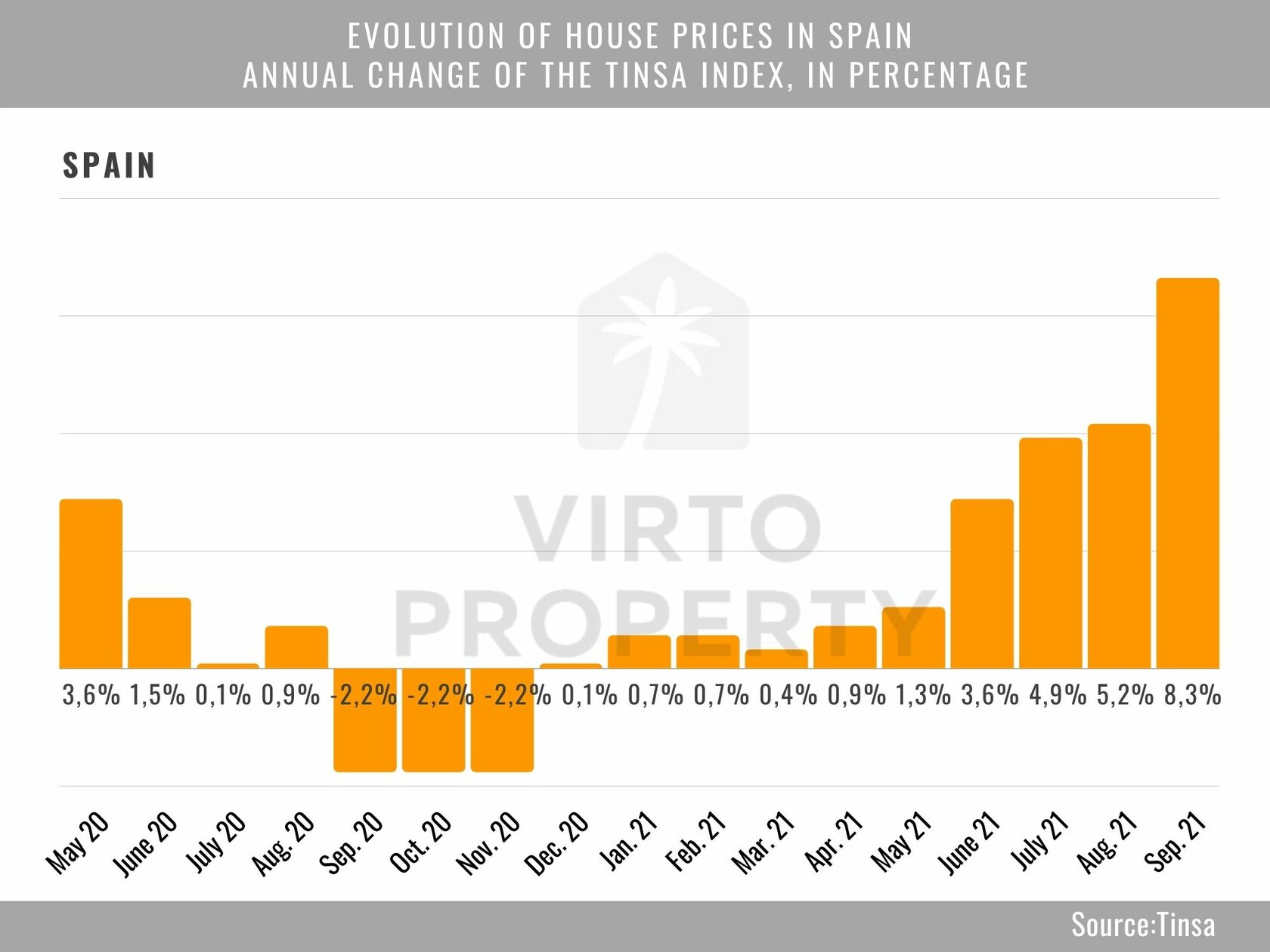
Since the beginning of the health crisis in Spain, new and resale housing has become 4.9% more expensive. “Changes since March 2020 demonstrate outstanding growth dynamics in the ‘Mediterranean coast’ and ‘Other municipalities’ groups,” explains Andrea de la Hoz.
Both groups are ahead of the national average: growth of 7% since March 2020 for the coast and 6.8% for “Other municipalities.” Below average: housing in the “Balearic and Canary Islands” group is 1.8% more expensive than at the beginning of the pandemic; in suburbs - by 3.7%; in capitals and large cities - by 4.6%.
Dynamics of maximums and minimums
Housing prices have grown by 23.6% since February 2015, when the general index reached its lowest point after the beginning of the 2008 financial crisis. In the Balearic and Canary Islands, housing has become 36.5% more expensive since their minimum values, in capitals and large cities - by 32%. In other locations, the dynamics were significantly more moderate: growth of 13.3% in small inland cities and 19.6% in suburbs. The Mediterranean coast occupies an intermediate position: +29.5% from minimums after the financial crisis, which is also above the national average.
Despite the upward trend and recovery to pre-crisis levels, housing on average is still 29.1% below the maximums reached during the construction boom. The gap is most noticeable on the Mediterranean coast (-36.7%) and in suburbs (-36%). On the islands, where the market was not so overheated during the boom period and where the subsequent fall was less sharp, the average cost is only 10.6% below the 2007 level.