Spanish Real Estate Market News for November 2021
Spanish Real Estate Market News for November 2021
The return of a ghost village, the return of foreign buyers, a boom in ultra-luxury hotels, and a 400 million euro tower. What was happening in the Spanish real estate market in November?
Foreigners are returning and buying more and more houses and apartments in Spain. Don’t lag behind them and the Spaniards - the number of buy-sell transactions has already exceeded the figures from 2008! We analyzed the trends that emerged in the Spanish real estate market in November, major deals and events.
- A tower in Madrid for 400 million euros
- The largest number of transactions in 13 years - new construction is in demand
- In Spain, it’s more profitable to buy your own home than to rent
- The return of a ghost after 30 years - what happened to the village of Aceredo in Galicia?
- How did the Barcelona city hall spend almost 10 million euros?
- Investment boom in Spain’s luxury hotel market
- Who and where is buying Spanish real estate? Sales of housing to foreigners grew by 47%
1. A tower in Madrid for 400 million euros
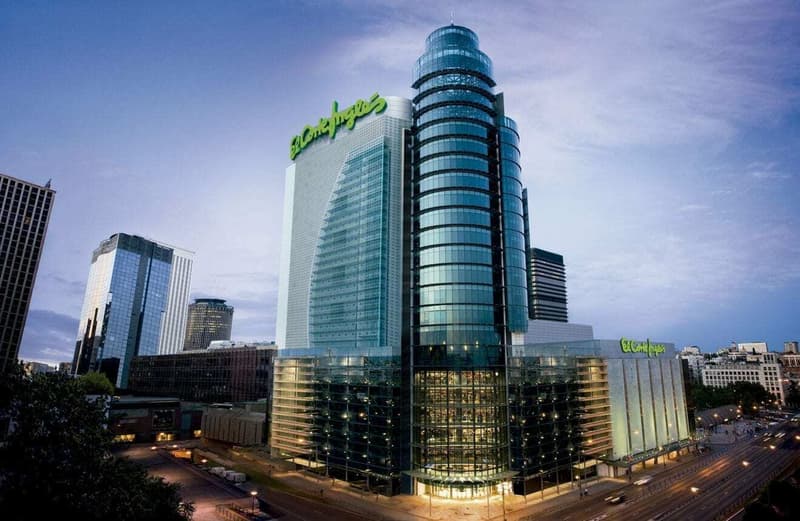
Torre Titania is Madrid’s twelfth tallest skyscraper and the country’s largest shopping center. Construction began in mid-2007 and was completed in 2013. However, El Corte Inglés stores have been operating here since 2011.
Philippine business holding Grupo Emperador offered Marta Álvarez’s company 400 million euros to purchase Torre Titania.
The 104-meter-high tower has 23 floors and is located on a prestigious site on Raimundo Fernández Villaverde street, opposite Nuevos Ministerios station and in close proximity to Paseo de la Castellana. El Corte Inglés occupies only the lower floors of the tower, while the remaining spaces are successfully rented out for offices.
The El Corte Inglés retail group has been disposing of non-core assets since 2015, selling commercial real estate. The tower in central Madrid and the land around it have long attracted investors, but until now all previous offers received by El Corte Inglés were considered insufficient. They have never been offered such a large sum for these assets, and it is quite possible that the deal will take place next year.
Moreover, Grupo Emperador is not new to the Spanish market. The holding has already acquired Torre Espacio from Grupo Villar Mir in the Cuatro Torres complex on Paseo de la Castellana in Madrid, as well as spaces in Torre Caleido and Torre Diagonal in Barcelona. Additionally, the group has invested in local wineries: Fundador, Terry, Harveys, Esplendido and Tres Copas.

2. The largest number of transactions in 13 years - new construction is in demand
The real estate market is taking stock of the year and making forecasts for the future. So far, the prospects for sellers look quite optimistic.
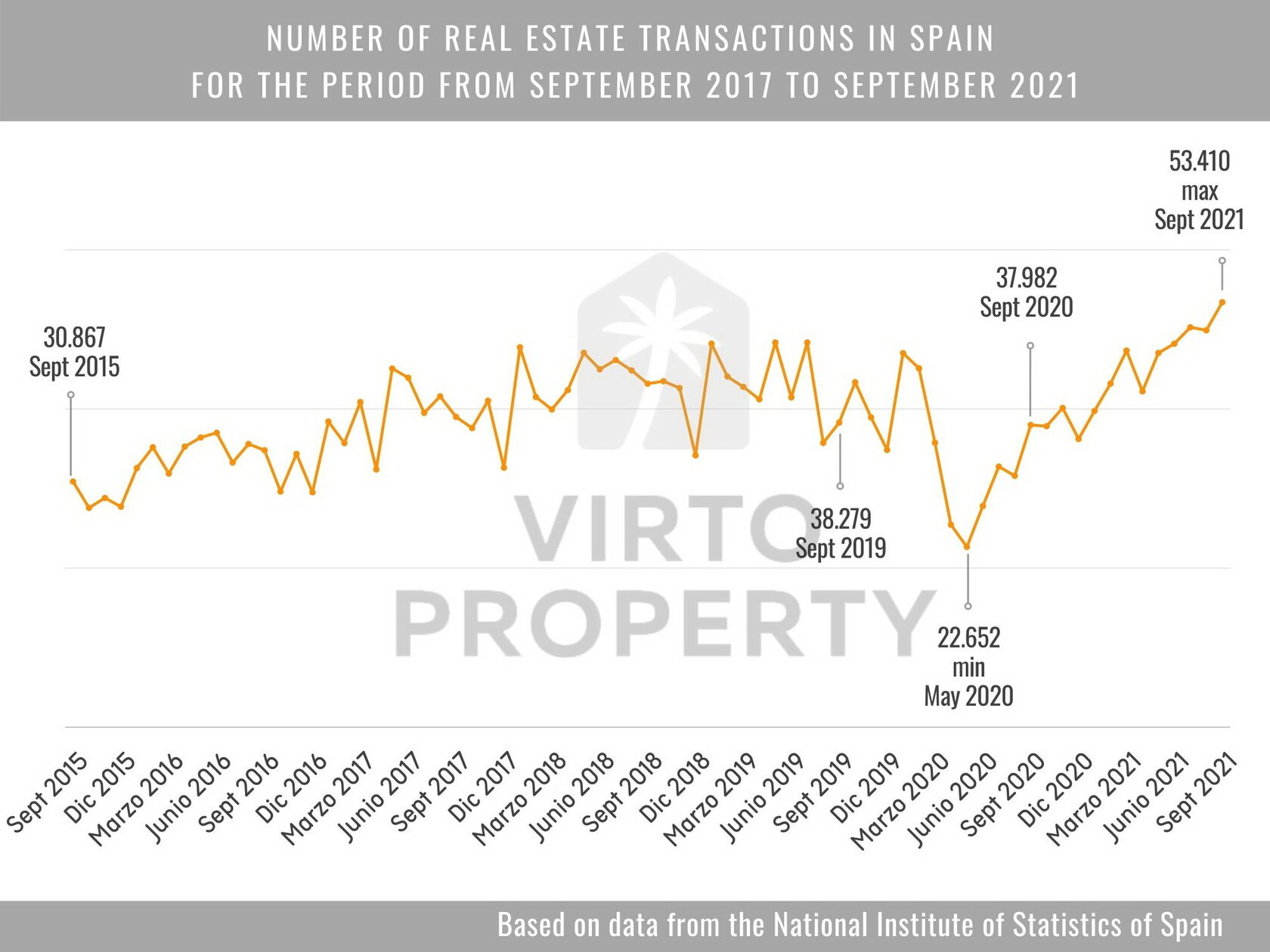
According to data from Spain’s National Statistics Institute (Instituto Nacional de Estadística), 53,410 real estate purchase-sale transactions were registered in September. This is a growth of 40.6% year-on-year and 7.1% compared to September 2020. The figures by themselves may not be too indicative, but this is “the largest number of registrations in 13 years!”
Among the provinces, the Valencian autonomous community leads in the number of transactions, with 190 transactions per 100,000 inhabitants.
An interesting trend is the change in buyers’ preferences in favor of new construction: new construction accounts for 20.5% of all transactions, and although statistically the majority of transactions are still related to secondary housing - 79.5%, demand for new construction has grown by 30% over the year.
New construction in Spain is currently experiencing a real boom, and this is not only related to the revival of construction work after the pandemic.
Spaniards choose new construction for a number of reasons, including the obvious advantages of this type of housing, notes María Matos, representative of Fotocasa. The figures for new construction could be higher, but the supply in this market is limited.
We observe the same trend. Over the past 9 months, the ratio of new construction to secondary housing has changed dramatically. This year, 71% of all Virto Property transactions are for new construction.
— Sergey Sinyugin, General Director of Virto Property

3. In Spain, it’s more profitable to buy your own home than to rent
Calculation method
The analysis was conducted by UVE Evaluations by calculating the mortgage payment corresponding to a loan of 80% of the offer value, with a term of 24.58 years and an interest rate of 1.52%. Average figures for June 2021 published by the Spanish Mortgage Association were used as source data, as well as data on property sales and rentals from the Idealista portal.
Based on this data, the mortgage payment (1), rental price per square meter (2) were calculated, and it was determined what percentage the mortgage payment constitutes in relation to rent (3). If this indicator exceeds 85%, it is a fairly reliable indicator that rental is the best option in that municipality.
Indicators in the range from 75% to 85% are not so clear-cut, and each case needs to be considered individually. But if the ratio is below 75%, buying real estate is almost always preferable.
| Municipality | Mortgage per sq. m | Rent per sq. m | Share of mortgage from rent, % |
|---|---|---|---|
| TARRAGONA | 3.61 | 8.07 | 44.73 |
| TALAVERA DE LA REINA | 2.43 | 5.27 | 46.11 |
| MURCIA | 3.45 | 7.27 | 47.46 |
| LLEIDA | 3.47 | 7.03 | 49.36 |
| SAN CRISTÓBAL DE LA LAGUNA | 4.03 | 7.87 | 51.21 |
| REUS | 3.54 | 6.87 | 51.53 |
| CHICLANA DE LA FRONTERA | 4.64 | 9.00 | 51.56 |
| EL EJIDO | 3.30 | 6.40 | 51.56 |
| MANRESA | 3.88 | 7.40 | 52.43 |
| ALGECIRAS | 3.38 | 6.40 | 52.81 |
4. The return of a ghost after 30 years - what happened to the village of Aceredo in Galicia?
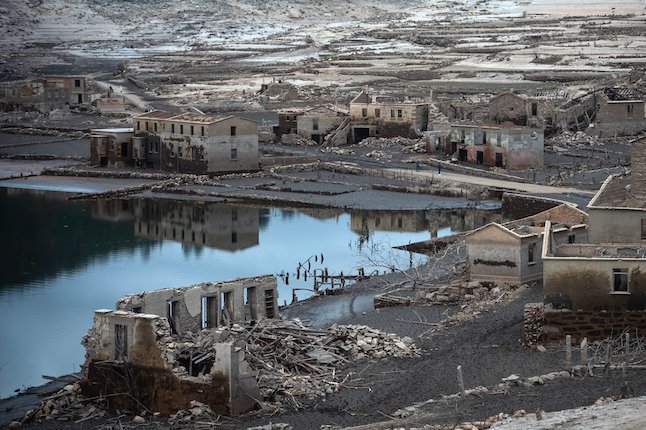
In 1992, the Galician village of Aceredo was intentionally flooded to build a dam and reservoir. It all began with an international agreement signed in 1968 between Spain and Portugal for the construction of the Lindoso dam. Although the dam and reservoir became significant engineering achievements, the project required Spain to flood part of its territory - practically forever.
The process of relocating residents proved difficult, but in 1992 they had to leave. Aceredo and four neighboring villages - O Bao, Buscalque, La Reloira and Lantemil - went underwater. So why did Aceredo specifically attract attention?
The reservoir water level changes depending on the season, and Aceredo, located on higher ground, reappears year after year. In other villages, when the water level drops, only the tops of buildings and church spires are visible. But “water completely left Aceredo for the first time in 30 years,” and now you can walk along its streets.
Over three decades spent underwater, houses filled with mud, and metal began to rust. But when the water receded, it turned out that much remained untouched. Car skeletons and personal belongings, though covered in mud, remained in the same places where local residents once left them.
And even the drinking fountain still works - clean water continues to flow from it, despite having no one to drink it.
What was seen looks quite frightening in photographs. One can only imagine what it was like for the residents of Aceredo to see their homes, many of whom moved to neighboring settlements. Journalists captured how they wandered confusedly through the newly opened streets, entered empty houses and looked at what was once their world.
It really looked like the return of a ghost.
5. How did the Barcelona city hall spend almost 10 million euros?
How the right of first refusal works, established in Decree-Law 1/2015 of March 27
The right of first refusal and redemption of the Generalitat of Catalonia arises when the transferred real estate was acquired after April 9, 2008 on the following grounds: in the process of mortgage foreclosure, by court decision, when repaying debt, or as payment.
In these cases, the seller is obligated to notify the Catalan Housing Agency of the decision to sell the property. The administration has two months to decide on exercising the right of redemption, after which it is considered to have waived it.
In November, the Barcelona city hall exercised its right of first refusal and purchased a residential building from the owner for 9.95 million euros to turn it into social housing.
The building owners were going to sell it and had already received an offer. But the city hall used its right to withdraw from the deal.
Then Mayor Ada Colau decided to buy out the building to increase Barcelona’s municipal housing stock.
The 3,976-square-meter property, located in the Eixample district, includes 33 apartments, several commercial premises on the lower floors, as well as an attic, loft spaces and storage rooms.
According to estimates by the idealista portal, the average cost of renting an apartment in this area is 1,211 euros per month, and in this particular building room rental cost 368 euros per month according to 2014-2018 data. So it remains a question of who won in this situation: the owner forced by law to maintain rent at the previous level, or the city that bought a far from new building for such an amount.
Why did the Spanish press pay so much attention to this purchase? The mayor’s supporters talk about protecting the rights of the poor, while her opponents speak of irrational budget spending and inability to manage the housing stock.
6. Investment boom in Spain’s luxury hotel market
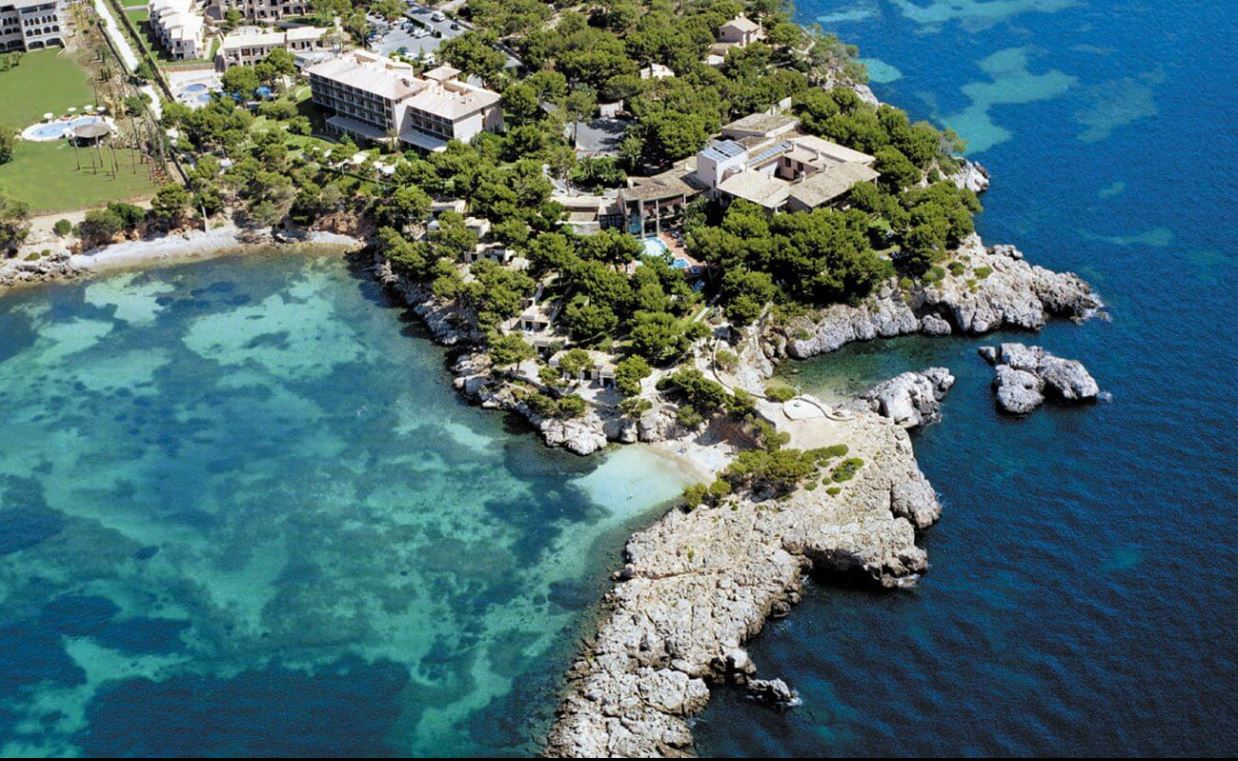
Spain is becoming a favorite of international capital - financial groups and international investors have intensified work with the country’s luxury hotel assets. This is connected to the recovery in demand for tourist services and relatively low “entry” prices to this market.
Experts estimate the annual potential for deals in this segment at 2 billion euros for 2022. According to Colliers, by November 2021, investments in luxury and ultra-luxury hotels amounted to 2,602 million euros, and by the end of the year this figure will grow due to deals in the process of closing.
Here are just a couple of examples of recent deals.
One of the largest projects in Spain currently starting is Four Seasons Marbella Resort, which will become the gateway to the country for Belgian developer Immobel and American group Fort Partners. The companies are investing 740 million euros in the construction of an exclusive complex including a 120-room hotel from the Canadian chain and a residential complex with 55 villas, 75 apartments and 32 townhouses and private residences.
At the end of November, Blasson Property, founded by Antonio Pan de Soraluce, Francisco Meliá and Enrique Benjumea, is investing 180 million dollars in the Punta Negra hotel in Mallorca, managed by the H10 chain. This is a boutique hotel with 137 rooms, located on the Costa de Blanés coast, with private access to two bays with crystal clear water.
Also under the brand of the Canadian hotel giant, the future Four Seasons of Formentor hotel will open in summer 2023. Behind the project is the Andorran fund Emin Capital, which on behalf of various investors, including the Rodina family fund (investment instrument of the Mexican Chico Hernández family), acquired the asset from Barceló a year ago for 165 million euros.
The fund plans to reform the hotel and adapt it to Four Seasons standards with additional investments of about 70 million euros. “The entire process requires large-scale reconstruction while complying with environmental protection measures. The estimated timeframe is two years, so the opening is expected in summer 2023,” reported Emin Capital.
7. Who and where is buying Spanish real estate? Sales of housing to foreigners grew by 47%
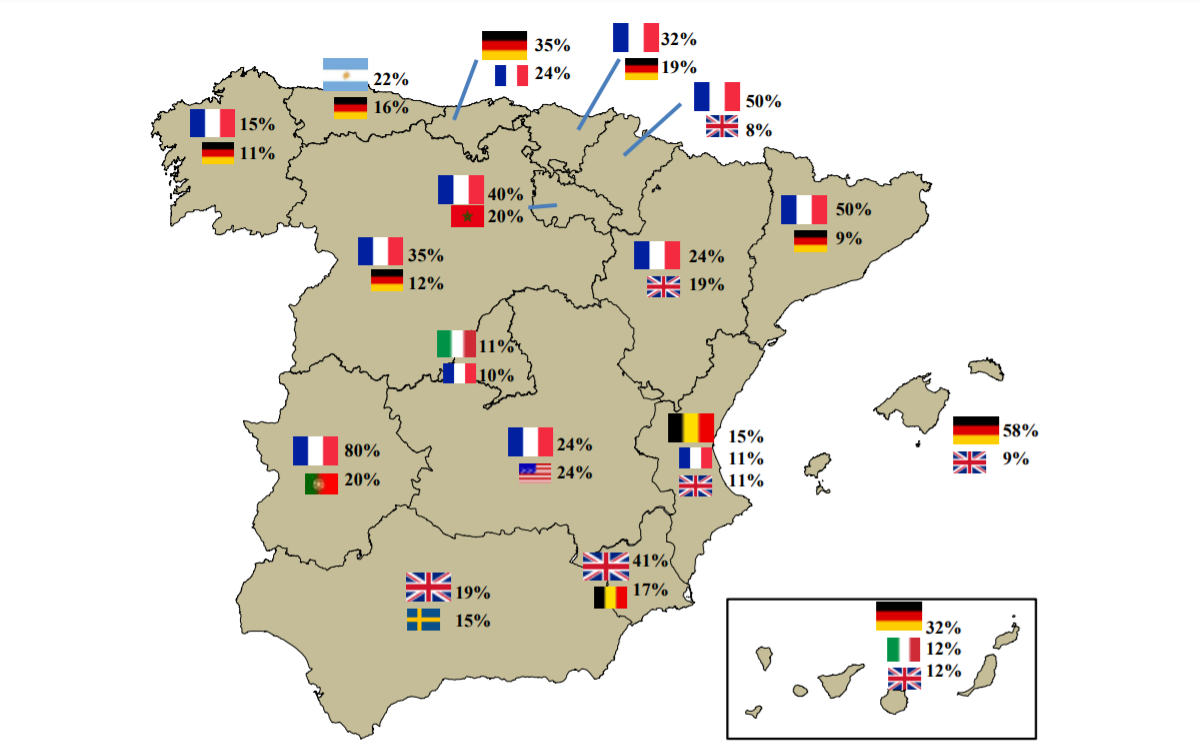
Last month, the General Council of Notaries (Consejo General del Notariado) published a report on real estate transactions made by foreigners. The number of housing purchases by foreigners in the first half of 2021 increased by 47.0% compared to the same period last year. The growth occurred thanks to the improvement of the Covid-19 situation and the natural decrease in the number of transactions during the quarantine period. Nevertheless, potential for growth remains: transactions made by foreigners constituted 15.4% of total sales across the country, which is below the average indicator for 2012-2019 (18.7%).
Where do foreigners buy real estate in Spain?
Sales grew in all autonomous communities, but the leaders were Asturias (83.2%), Galicia (81.8%), La Rioja (79.1%) and Castilla-La Mancha (76.3%).
Slightly above the national average (47%) growth was recorded in Castile and León, Aragon, Cantabria, Murcia, Andalusia and Catalonia. Statistics on the number of transactions compared to last year in these regions ranged from 64.7% to 49.8%.
The smallest growth was observed in the Basque Country (32.2%), Valencian Community (34.3%), Navarre (37.3%), Extremadura (38.3%) and the Canary Islands (39.0%).
It was noted that the French led in terms of the share of sales among non-residents in Castile and León, Aragon, Catalonia, La Rioja, the Basque Country and Navarre.
Germans, in turn, were the main buyers on the islands and in Cantabria, while the British chose Andalusia and Murcia.
Moroccans and Romanians avoid the regions of Galicia and the islands, as well as places with higher activity of buyers from Germany, Italy, Portugal or Great Britain.
Who buys Spanish real estate?
Moroccans (10.8% of all foreign transactions), British (9.7%) and Romanians (6.5%) are the top three by nationality among housing buyers in Spain.
If we consider countries outside the European Union, they account for 13%. Sales to foreigners of all nationalities grew, except for Swiss (90.2% of transactions from previous periods), Germans (75.1%) and Moroccans (74.8%).
What do foreigners prefer?
Non-residents buy more expensive houses and apartments than locals. The average cost per square meter in Spain was 1,481 euros, while foreigners purchased housing at an average price of 2,452 euros per sq. m.
The highest average prices per square meter were paid by buyers from Sweden (2,768 euros per sq. m), Denmark (2,680 euros), Germany (2,676 euros), Switzerland (2,464 euros), USA (2,266 euros) and Norway (2,223 euros).
In the next price segment, with an average cost of 1,863 euros per square meter, the leaders were buyers from Russia, as well as from the Netherlands, France, Belgium, Italy and Ireland.
British citizens who are residents of Spain paid an average of 1,580 euros per square meter. Those who do not have residency in Spain bought more expensive housing - on average 2,027 euros per square meter.
The lowest amounts were paid by Moroccans (640 euros per sq. m), Romanians (967 euros) and Ecuadorians (984 euros).